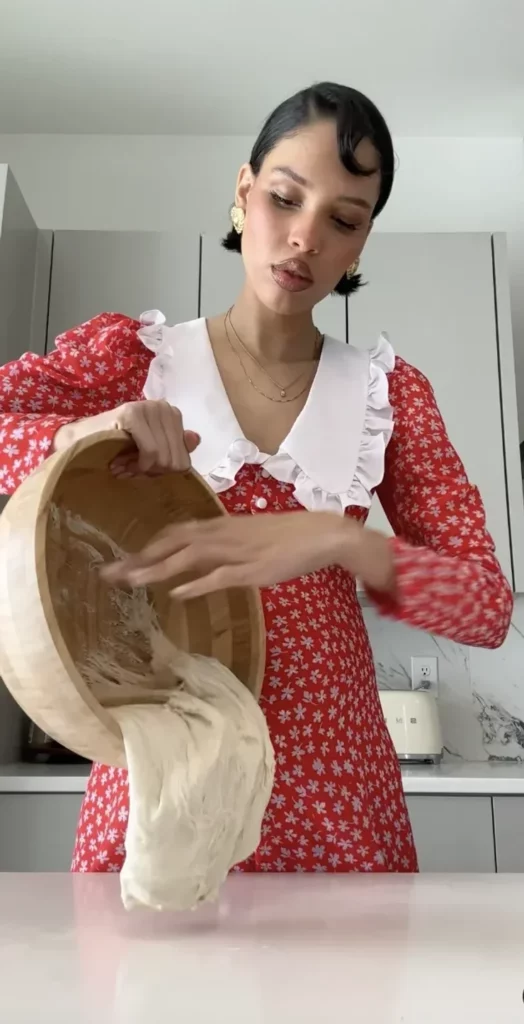
Almost every video begins in her perfectly illuminated, pristine marble kitchen. Nara Smith stands in the center of the camera frame looking equally clean and put together as her domestic surroundings: her hair slicked into a side-swoop, her face in a light layer of minimalist make-up, and wearing either a matching pajama set or a classy gown. In a recent video, her smooth voice echoes in the background as she narrates: “When I asked my toddlers what they wanted for lunch, they both wanted a grilled cheese, so that’s exactly what I got started on.” While I anticipated a classic American sandwich made with slabs of processed orange cheddar and Sara Lee bread, I watched in irritation and wonder as she extended what should have been a five-minute recipe into a three-hour project, not only making her own loaf of bread from scratch, but also her own butter, mozzarella cheese, and basil pesto. Upon opening the comment section, other viewers shared similar reactions of disbelief and anger at the sheer absurdity of making such a luxurious sandwich for a couple of toddlers. Even still, I found myself scrolling to the next video in search of the next overly extravagant meal she would make.
Nara Smith’s reputation on the internet has become widespread over the last couple of months with respect to her propensity for preparing labor-intensive dishes with unbelievable ease, and also in regards to her seemingly ideal home life. From what she portrays on her social media profile, Smith has achieved the American Dream; at only 22 years old, she is married to model Lucky Blue Smith, owns a house in Los Angeles, and is already expecting her third child. Smith is South African and German, and perhaps the most controversial aspect of her internet presence is her conversion to Mormonism upon marrying her husband. Smith has been labeled as the “modern tradwife” as her “day-in-the-life” videos often only take place within the walls of her home and center primarily on the foods that she prepares for her family throughout the day. Despite the visceral vexation I feel when a video of hers pops up on my For You Page in which she prepares a “lazy meal” of dijon and dill-marinated salmon with a baked potato and tzatziki sauce (all homemade, of course), I can’t help but watch the entire video, captivated by the artistic and aesthetic preparation process and longing to have the money, time, and therefore energy to do the same.

Credit: Getty Images
Nara Smith produces an inexplicable and unmatched sensation of anger and tranquility as she is able to perform simplicity and idealize homemaking. As a content creator, Smith uses food and cooking as a means of projecting and normalizing an elusively humble and desirable image of domesticity. Smith’s videos play into Dumitrescu’s idea of “good” taste; her dishes not only are made using all-natural, whole ingredients, but are visually stunning, colorful, diverse, and nutritionally balanced. Especially because Smith can afford so much time and energy, she furthers the appeal and novelty of her online content by going out of the way to make homemade alternatives of classic American junk food: Cheez-It crackers, Pop Tart pastries, and even Cocoa Puff cereal. On one video in which she made homemade cookies and cream ice cream (baking and assembling her own Oreos), one commenter notes “Do you ever just eat a bag of Cheetos?” As an influencer, Smith curates a reputation that emphasizes cooking her own meals as a medium for health, aestheticism, and social capital; indulgent, processed, or otherwise “bad” taste has no place on her platform.
Cooking such labor-intensive meals is intimately tied not only to her “good” taste as an influencer, but also to her ability to perform the unattainable ideology of the “intensive mother,” as posited by Sharon Hays. As a stay-at-home mom, she perfectly embodies the “good mother” who acts as the primary caregiver and archetypal housewife, committing all of her “energy, emotion, and attention” (Fielding-Singh) to supporting her family, specifically through preparing healthful and balanced homemade meals. She prepares not just any meals, but those that are specifically requested by her children and husband. Despite the romanticization and apparent liberty associated with being this intensive mother, it’s important to note the primary factor that makes motherhood such a glorified experience for Smith: inordinate amounts of wealth. Smith is a prime example of the “privileged, resourced mom” as she has access to childcare, groceries, cooking knowledge, a spacious, functioning kitchen, a financially successful, dependable partner: luxuries that most mothers simply cannot afford. As a social media presence, Smith has complete control over how she depicts life as a young mother and wife. Thus, she chooses to represent a simple, dream-like, and unbelievably easy lifestyle. Smith has more luxury and time not only to prepare the homemade croissant bread pudding breakfast or the steak and potatoes dinner for her family of four, but to film, edit, and share a hyper idealized narrative of motherhood and feminine domesticity with her millions of followers. With her rising reputation as an influencer, she wields the power to standardize this narrative.
Credit: Paypath
Ultimately, Smith knows how to strike a careful balance in her content, using mesmerizing and romanticized visuals of food preparation as a medium to perform and naturalize an unattainable version of domesticity and motherhood. I fervently disagree with the illusion of accessibility and ease that Smith propagates on her platform, as it has negative implications on how the public perceives the role of the American mother and enforces hierarchies of taste, both economically and culinarily. However, the actual content of her videos is entertaining and desirable, as exemplified by a user’s comment: “Not Nara making me want to be a housewife, I’m a man.” Watching her carefully crack eggs into a bowl or thinly slice a bunch of scallions with her low, smooth voice resounding in the background is admittedly addictive, and keeps us scrolling. Resultantly, we sit in this perplexing state of jealous satisfaction, scarfing down fistfuls of SmartFood as we watch her indulge in a “quick” midnight snack of pistachio ice cream with homemade caramel sauce and cookie dough.
Sophia is a fourth-year student from Jersey City, New Jersey majoring in Hispanic Studies and Comparative American Studies.
