When farmer’s markets and home gardeners prepare to shut things down for the winter, a final abundance of the harvest season is often chard. Rainbow chard, core to the beauty and flavor of this recipe, is a hearty green with a unique flavor profile. There is an earthy component, a bitterness, and the anise-like sweetness of beets. Suffice it to say, this might not be the ideal vegetable for picky children. Its ribs (the thick central stems), however, caramelize into a sweet, mellow “ragu” in this unique recipe. I learned how to make this recipe working on a farm in Abruzzo, Italy. The farm’s restaurant produced dozens of timbale per night, delicate pillows of mashed potatoes wrapped in a single leaf of blanched rainbow chard. In my weeks working in their kitchen, I folded hundreds of timbale but failed to ever produce the perfect squares they plated as an appetizer. For each delicate leaf, however, came a rib which the kitchen cooked into perhaps the most decadent vegetarian dish I have ever eaten.
Returning home, I was struck by the beauty of this recipe. Seasoned chefs will be familiar with the tough cellulose that comprises the ribs of chard, kale, and other hearty greens. They are often considered to have almost no utility because of their texture. Since they take exponentially longer to cook than the leaves to which they are attached, they often go uneaten or, in the best-case scenario, are tossed in a freezer bag to flavor a broth in the future. In this lasagna, they star.
Do not purchase pounds upon pounds of chard solely to make this recipe. Either save the ribs and stems from every hearty green you eat in a freezer bag for a month or wait until you receive a windfall of chard from a farmer’s market, a neighbor, or your own backyard. If you opt for the freezer method, simply chop the ribs into quarter-inch pieces before freezing and anticipate an additional five minutes of cooking time as they release excess water from their broken cell walls. I would recommend stems from kale, beet greens, mustard greens, and bok choy but steer clear of vegetables with higher water by volume like broccoli. If you make this recipe because you’ve suddenly received a bushel of chard, make it a feast by tearing away and sauteeing the greens as a side dish to the lasagna. They will lose far more volume than the ribs as they cook, so anticipate feeding two people with each bunch of chard you buy.
As daunting as the process may be, the final product for this recipe is epic. Active time spent cooking should not exceed a couple of hours, but if you’re able to start the day before, the beautiful single-portion slices are worthwhile. Since pan sizes vary, assume that there will be leftovers of one or more components. Feel free to try to squeeze them all in, but having extra bechamel around the house will not hurt you. The final lasagna belongs at a joyous dinner party, perhaps with a very dry white wine and a lot of friends you want to impress.
Serves 8-10
Active cooking time: 90 minutes, total cooking time: 3-24 hours
Vegetables
4 yellow onions, diced into quarter inch pieces
4 medium-sized carrots, peeled and diced into quarter inch pieces
2 heads of celery, halved lengthwise and sliced into quarter inch piece
4 bay leaves
1 tablespoon thyme, rosemary, or herbes de Provence
1/2 cup dry white wine
3-4 cups fibrous vegetable scraps*
Olive oil
Salt
Bechamel
Scant 1/2 cup all-purpose flour
6 tablespoons butter
3 cups milk
2 teaspoons kosher salt
1/2 teaspoon nutmeg
1/2 teaspoon freshly ground black pepper
Pasta (if making fresh)
1 bunch fresh spinach or 5 ounces (1/2 package) frozen spinach
2 cups all-purpose flour, plus more for kneading
3 eggs
1 teaspoon salt
Assembly
1 pound lasagna sheets (if using store-bought), cooked according to package instructions
1 cup grated, low-moisture mozzarella
1 cup grated aged cheese, in order of best quality (and price): Parmigiano Reggiano, Pecorino Romano, domestic parmesan
Pesto, tomato sauce, or extra bechamel for serving
*Use all rainbow chard ribs for the prettiest results. Stems from any leafy green will be wonderful. Low moisture alliums like leeks are a welcome addition. If you use a lot of, say, asparagus, prepare for this dish to taste mostly of asparagus.
Instructions:
Sauce
1. Finely and uniformly chop all vegetables. The resulting sauce should emulate a meat sauce, so its texture should be uniform. Pay special attention to dicing carrots rather than cutting them into coins, they should soften and disappear into the sauce.
2. Saute carrots and onions over medium-high heat in a thin layer of olive oil with the bay leaves and a generous pinch of dried herbs. Salt liberally to draw moisture from the onions. Stir only rarely to encourage subtle browning. Liquid will pour from the onions and carrots, boil, then evaporate. The carbohydrates dissolved in this water should begin to caramelize and form a fond on the bottom of the pan. This browning is wonderful, but be extremely careful not to let it burn. The onions should not fully caramelize, but since this sauce has no tomatoes, this is the only opportunity to develop brown, roasting flavors.
3. Once a light brown fond has formed on the bottom of the pan, deglaze with the white wine. This lasagna should have strikingly little acidity, so allow most of the wine to evaporate until little visible moisture remains.
4. After almost all the wine has evaporated, add the celery, chard ribs, and any other stalks and stems that are handy. If a few leaves make their way into the sauce it won’t ruin anything, but they will cook down to almost nothing and interrupt the smooth texture of the vegetables, so try to avoid them.
5. Simmer until all vegetables are translucent and the water they released has fully reduced.
6. Fish out the bay leaves and discard.
7. Remove from the heat and let cool.
Bechamel
1. Melt butter over medium heat in a saucepan.
2. Whisk flour into butter, stirring constantly until mixture bubbles forming a roux.
3. Add milk, beginning with less than a half cup, then increasing quantities. The roux will break immediately, so whisk until no clumps remain, then add more milk.
4. Season liberally and let cool.
This lasagna requires cooked pasta. Raw fresh pasta or “instant” lasagna sheets will suck moisture from both sauces. On the farm where I worked, they used beautiful green pasta, but regular store-bought pasta would be wonderful as well.
Green pasta
1. Prepare spinach. If using fresh spinach, blanch it in boiling water for 15-30 seconds, then shock it in an ice bath. This process is essential to preserving color. If using frozen spinach, simply let it thaw. Regardless of which spinach is being used, drain excess moisture over a colander.
2. Blend spinach on high until it forms a homogenous, bright green paste. Add eggs and salt and blend for 10 seconds to combine. Avoid over-blending the eggs as they will aerate quickly.
3. Knead the spinach mixture into the flour for around 10 minutes, or until the dough is elastic and can easily be stretched thin enough for light to shine through without breaking. Add more flour as necessary while kneading to keep the dough from sticking.
4. Let the dough rest for half an hour, then using either a rolling pin or a pasta machine, roll it to lasagna thickness. If using a pasta machine, this will not be the thinnest available setting, aim for around 1/6th of an inch thick. If using a rolling pin, roll it as thin as possible. Slice into rectangles around 4” x 8” and dust with flour to avoid sticking.
5. Boil for around three minutes. When the sheets rise to the top of the boiling water, they have cooked through. Lie them flat on kitchen towels to prevent them from sticking to each other.
Once your base ingredients have been prepared, you can either make the lasagna the way I learned to make it for a restaurant setting with beautiful individual portions, or you can do it the sane way. Both processes are detailed below:
Restaurant preparation:
1. Line a deep casserole dish with plastic wrap both horizontally and vertically and leave enough plastic wrap so that it drapes several inches over the rim on each side.
2. Spray the plastic liberally with a nonstick spray, then create a base layer of pasta. Alternate thin layers of bechamel and vegetables between the sheets of pasta. This process will be substantially easier if both sauces have chilled. Save at least 1/3rd cup of bechamel. Finish with a layer of pasta, spray the top with more nonstick cooking spray (or brush olive oil over it), wrap with the overhanging plastic wrap, and freeze, for at least overnight or up to a few weeks.
3. Preheat oven to 350º F.
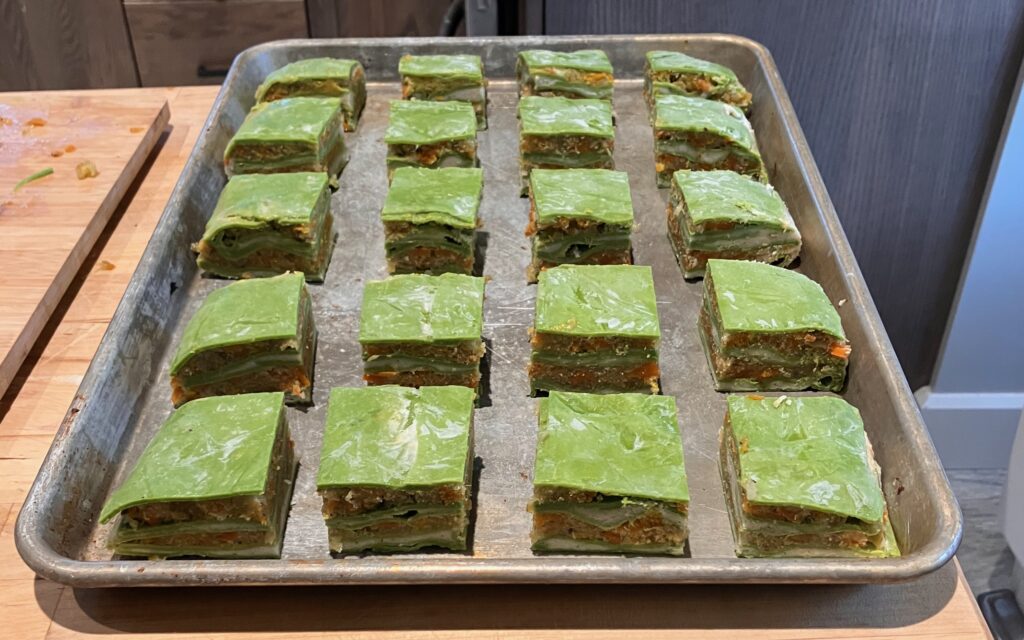
4. Working with a serrated knife, slice the frozen lasagna brick into single serving sizes. A serving will vary based on the size of the pan and depth of the lasagna, but around 3” x 3” should be more than enough for a filling portion.
5. Place the slices on a sheet pan with copious space between them and bake. Baking time will vary based on the size of each lasagna slice, but it should take around 40 minutes for them to cook through and brown on the edges and top. Feel free to probe the lasagnas with a meat thermometer and ensure their internal temperature is above 135º F.
6. Set oven to broil or turn oven temperature to 450º. Top each slice with a thin layer of bechamel and a heavy sprinkle of mozzarella and parm. Bake until the top is bubbling and golden brown. Remove from oven and let rest for 10 minutes.
7. Serve atop a tomato sauce or pesto. This sauce’s acidity will cut through the rich lasagna, creating a heavenly eating experience. There is something wonderful about the heterogeneity of a creamy entree and a bright sauce. Your guests will be blown away.
Sane preparation:
1. Preheat oven to 425ºF.
2. Grease the bottom and sides of a casserole dish. Then begin layering your lasagna. The top and bottom layers of this dish should be bechamel for optimal crispiness. Cover the lasagna with a deluge of cheese. Tent a sheet of foil over the pan to prevent the top from burning. The sides do not need to be sealed and make sure there is at least an inch gap between the foil and cheese so it does not stick.
3. Bake for 30 minutes, remove the foil, and bake for at least 10 more. Pull from the oven when the top of the lasagna is bubbling and golden brown. Remove from the oven and rest for at least 20 minutes.
4. Enjoy with a side bowl of bright, fresh tomato sauce or pesto to garnish.
It occurred to me while testing the recipe I wrote for this scrap lasagna how bizarre it was to intentionally create a waste product. I bought turnip greens and bok choy, tore off the leaves, and set out to use only their stems. I explicitly discouraged that approach in this recipe for the same reasons I believe that this recipe is political. Making a showstopping, satiating centerpiece of a dish out of what would normally end up in a compost bin is a political act. Growing one’s own food, shopping at the farmer’s market, and any other means of acquiring food that leads to brief, seasonal bounties (of what are not necessarily the most popular vegetables) are quiet repudiations of a food system that guarantees raspberries in February and oysters in Iowa. This was developed in Italy as a recipe for microseasonality; an ephemeral moment to savor a single vegetable at its peak. I have expanded it as an opportunity to get rid of scraps that would otherwise land in the compost.
I developed this recipe from my memories of watching three extremely talented chefs, Cristina, Margherita, and Eleonora, all of whom worked, at minimum, about seventy hours per week. They toiled over the beautiful produce Margherita and Eleonora’s husbands grew, attempting to feed their families, employees, and dozens of guests every night. In this recipe, I wanted to convey their extremely careful approach to avoiding waste. I witnessed only parts of May and June, so their seasonal prix fixe menu remained fairly consistent my entire time at their farm, Terra di Ea. While I explain in my recipe how carefully the waste product of their chard was collected, I leave out how this approach was applied elsewhere, like the zucchini skins that were wrapped around mozzarella and anchovies to be fried while the zucchini interiors were blended into a bright, minty sauce poured over crisp lardons of guanciale and hand rolled cavatelli. On a prix fixe menu at an agriturismo, this approach is more than just economical, it highlights for the guests the labor and time required to produce each vegetable. That aligns with the experience of the home gardener: the knowledge that each precious leaf and stem grown costs an order of magnitude more money and effort than purchasing it at the grocery store and the desire to truly savor every bite.
For a time, the standardization, preservation, and processing of food were seen as paramount to health and played a key role in the United States’ international hegemony. Cooking against these ideas is a political project of its own. In his book Taste of Control: Food and the Filipino Colonial Mentality Under American Rule, René Alexander D. Orquiza Jr. explains how incurious Americans with no interest in the rich culinary history of the Philippines deemed local food (which at that point already had colonial influence from Spain) unhealthy. The American expat community was repulsed by unfamiliar stews and starches and decided accordingly that it could not possibly be good for them. As such, they brought in products like marshmallows and hotdogs. Heavily processed products with standardized recipes, long shelf lives, and flavors ubiquitously familiar in the West. Orquiza’s book even includes an advertisement for a Filipino ice cream from 1927 directly associating the processed food with whiteness and, bafflingly, health. As if any processed food was, by proxy, healthful.
A brilliant political intervention to these colonial ideals comes from chef Angela Dimayuga in her cookbook Filipinx: Heritage Recipes from the Diaspora. Dimayuga counters the concept of “authenticity” with a fusion of diasporic interventions into Filipino cuisine. She shows the reader the complexities of identity for a Filipinx person in the diaspora, melding together precolonial, Spanish, and American influences. Perhaps the perfect illustration of this pairs brilliantly with my recipe: Filipino Spaghetti. I have long been passionate about Marcella Hazan’s groundbreaking 1973 tome The Classic Italian Cookbook, so I was thrilled to see Dimayuga reference Hazan’s bolognese here. It’s perhaps the only recipe other than chocolate chip cookies I have truly memorized. Here, she swaps coins of hot dogs for some of the ground beef, playfully honoring the kind of food that is packed with preservatives so that it can last through the seasons.
The hot dog bolognese feels like an apt foil for my pasta, designed for such a narrow window of time. Both take a cautious approach to the complexities of our modern global food system, not fully condemning, but certainly contemplating. How strange it is to eat a blended slurry of meat from animals that died months ago, yet how delicious. Sure, my recipe is designed to make the most of a bulk vegetable which could otherwise go half to waste, but even the fancy farm-to-table farm restaurant that made this lasagna relied on massive orders of the celery, carrots, and onions for this sauce’s mirepoix.
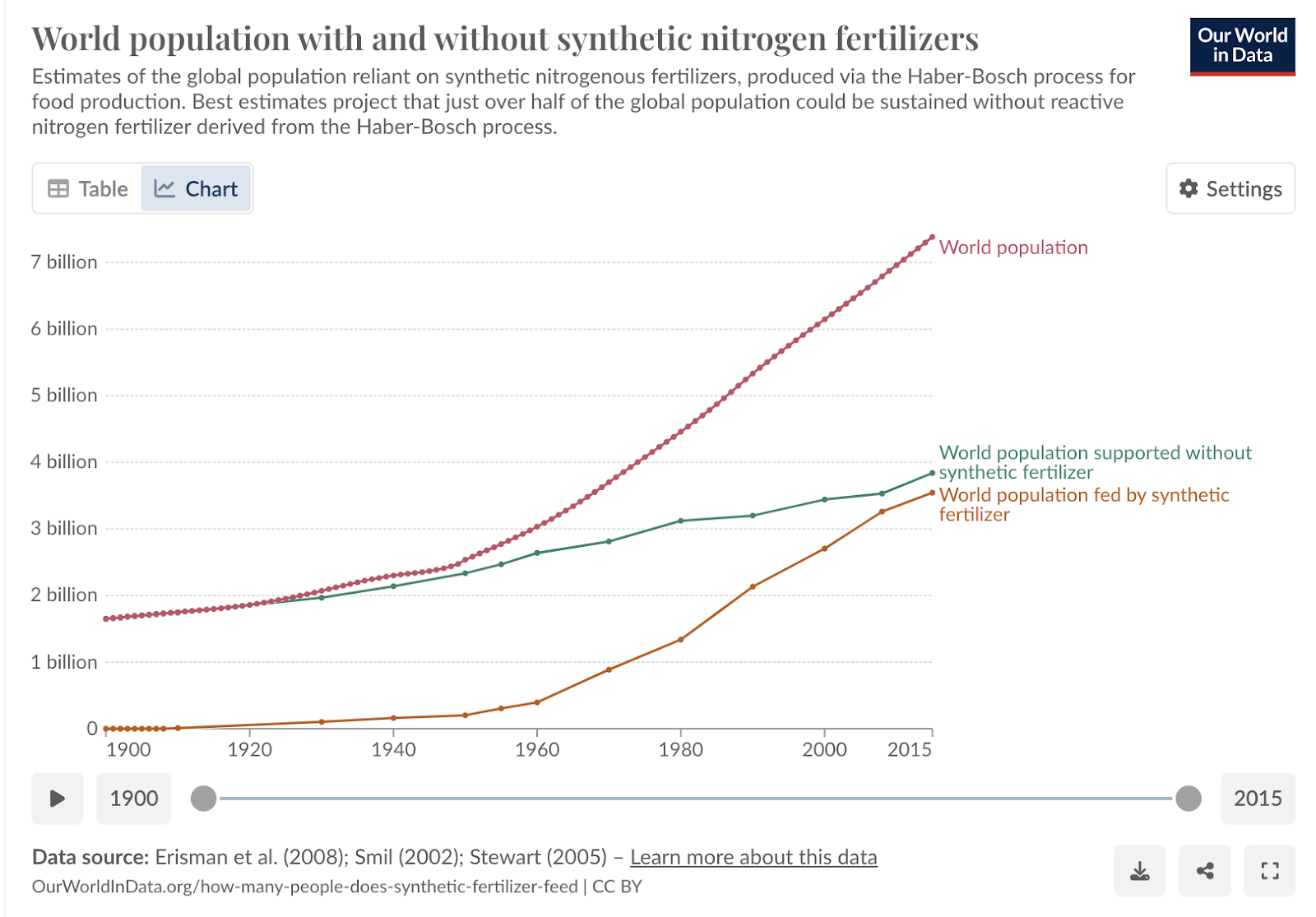
Our globalized food system has developed into something so complex and intricate that to simply problematize it almost misses the point. I don’t know if I believe it’s bad that I can reliably get a bag of carrots at any grocery store in America. Maybe it’s bad, but mostly it just is. It is the case that we produce enough food for every person on the planet. It is the case that we have done that through complex, imperfect science like genetic modification and synthetic fertilizers.
When I look at this graph (from Our World in Data) of what the world’s population would be without nitrogen produced by the Haber-Bosch process, the trillions of ways our world would be different without it astound me. There are real ways our food systems need to shift. The fact that we produce enough food to feed every person on the planet but let hundreds of millions go hungry is a failure of human systems. That we produce that much food in the first place is wonderful and bizarre and has been built by a system with no regard for locality, seasonality, or cultural identity. My recipe is political in that it provides an alternative to our massive, neoliberal systems, but it does not begin to address where we go next.