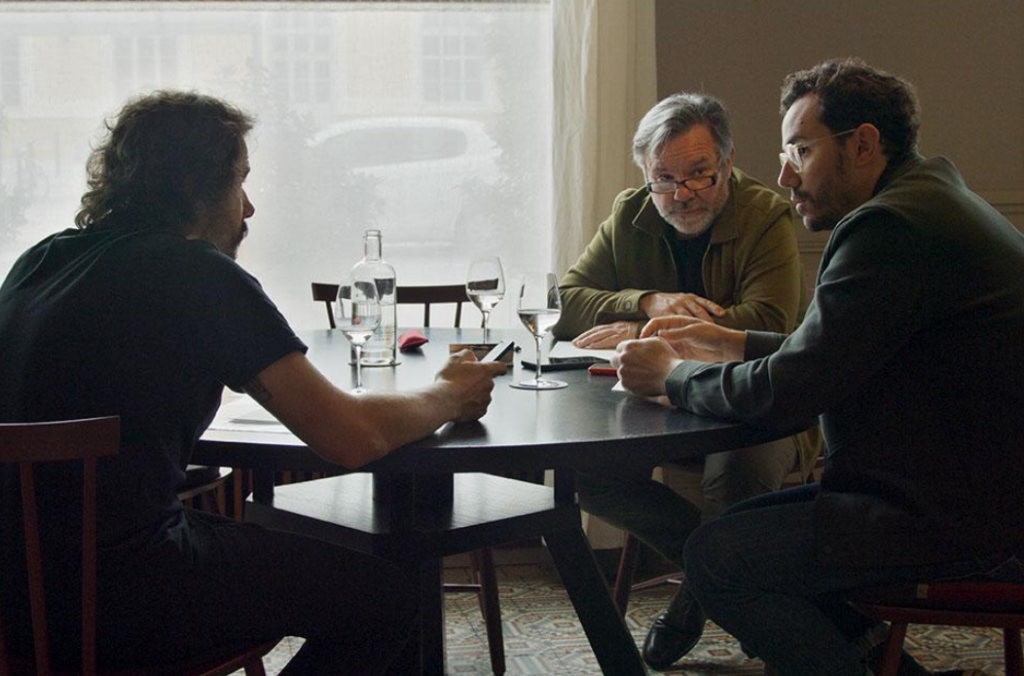
At the onset of Frederick Wiseman’s 2023 documentary Menus-Plaisirs – Les Troisgros, three men sit around a table debating passionately about the ethics and implications of dressing a bed of blanched asparagus in a tart rhubarb glaze. In this nearly twenty minute long unbroken shot, the conversation is slowly revealed to be about far more than experimental asparagus preparations. A unique familial dynamic is revealed as Michel Troisgros, the father of César and Léo Troisgros, scolds his sons for insisting on promoting “avant-garde” flavor combinations for use in their family restaurant– La Maison Troisgros. The acclaimed farm to table restaurant in Ouches, France has been home to three Michelin stars for over fifty years, along with boasting two sister restaurants also owned and operated by the Troisgros family.
This subject matter appears to be a rather unique undertaking for prolific documentarian Fredrick Wiseman. At ninety-three years old, Wiseman has made a name for himself in crafting complex cinematic portraits of a variety of “third places”– Central Park, Boston’s City Hall, The New York Public Library, The National Gallery, and many more. Each of these career-defining documentaries has taken an observational, “fly on the wall” approach to capturing the spirit of these places and the people that gather there. While Wiseman may return to the board of trustees meeting in New York Public Library several times throughout the whopping three and a half hour runtime of Ex Libris, these board members are viewed less as characters and more as cogs in the wheel of the library. In much of Wiseman’s filmography, the places themselves can be thought of as the central protagonists, presenting their own character and personality in tandem to the people who utilize them.
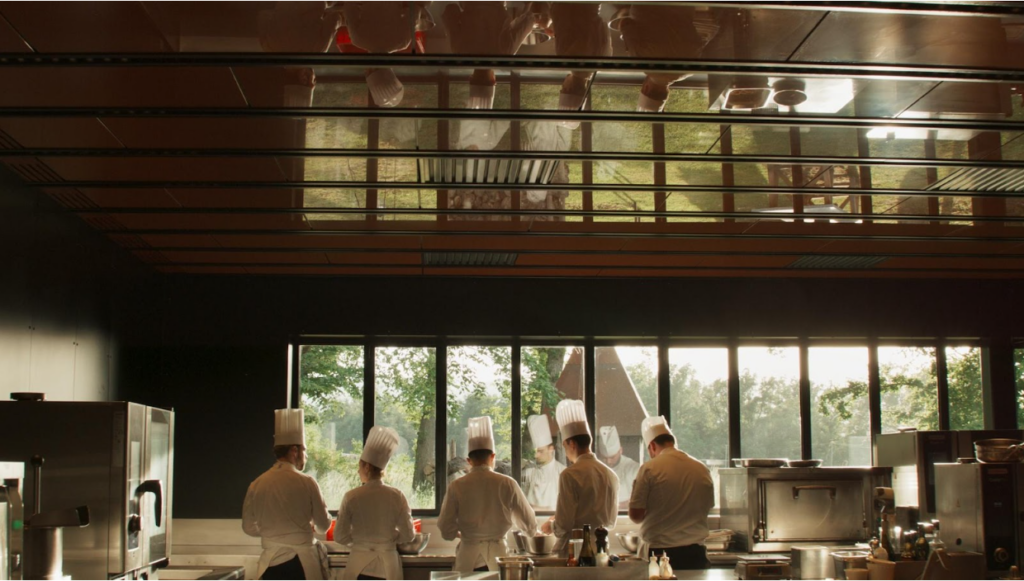
However, Wiseman treats the Troisgros in a much different way from the board of trustees in Ex Libris, primarily because of their inextricable ties to the restaurants which are centered in the film. Yet, there is still a certain amount of distance held between the camera and these chefs. As with many of Wiseman’s other documentaries, their complex father/son and brother/brother dynamics are not shown through talking head interviews or other confessional style dialogue. Rather, we observe these dynamics as they play out naturally in the large, open air kitchen of La Maison Troisgros, or around the table as they discuss ideas for potential dishes. The result of this distance is a palpable sensory experience, much like the environment of Maison Troisgros itself. Over the four hour runtime, I caught myself leaning in to listen closer to observed conversations between the three Troisgros men, grasping for moments of tension and conflict amidst a fairly subdued family dynamic. Seeing as we only learn about them through their discussion of recipes, instructions to cooks, or descriptions of complex flavor profiles– the unique sensory experience of their craft extends into the ways in which the audience learns to read their character.
The sensory experience of Menus-Plaisirs – Les Troisgros extends far beyond the affect of the Troisgros family. At the center of Wiseman’s film lies the elaborate five course meals, wine and cheese pairings, local artisan dairy farmers, complex flavor profiles, and of course, the guests who dine at La Maison Troisgros. Just as we learn about the Troisgros family, we are introduced to each of these guests through their interactions with the food, the servers, and the space of the restaurant itself. La Maison Troisgros stands out from other subjects of Wiseman’s filmography which many would consider to be “third places”– those with low entry fees and which encourage the building of community. All three of the Troisgros restaurants (and subsequent hotel lodgings) come with a hefty price tag and nearly impossible dinner reservation. Thus, we experience this space through this lens of elite fine dining. The servers must set the tables in a hyper specific way, offer specific information about the origins of ingredients and wine pairings, and undergo a highly choreographed dance of setting tables and arranging dainty platters of foie gras. The audience also experiences the many chefs purely through the food that they make– each of them wears a tall, white, chef’s hat, but only one of them is tasked at meticulously deveining the goat brains for dinner that night.
Throughout the film, Wiseman allows his audience to experience spaces and people holistically, encouraging viewers to lean in closer and investigate what they see or hear before them. Menus-Plaisirs – Les Troisgros could be described as a wholly atmospheric experience. Its four hour runtime allows for minutes of near silence, watching servers whisk away fresh silverware and show people to their tables. Menus-Plaisirs – Les Troisgros is not merely a portrait of the Troisgros family or their storied history in the restaurant business, but also functions as a poignant reflection on the ways that humans savor food and labor over the precision of culinary craftsmanship. If you lean in close enough, you might just be able to smell the aromas of lemongrass and escargot wafting from the kitchen.
Imogen Pranger is a 4th year Cinema & Media major at Oberlin College.
