Salads are a relatively modern meal. Sure, salads of all types have existed for thousands of years, but they have usually functioned as a side dish, or the vegetable portion of a meal. But salads as a meal feels very twenty-first century to me, and modern salads are laden with both factual and manufactured ideas about healthfulness. Salads as a meal, as opposed to, say, a sandwich, represent a sort of superior healthiness due to their high vitamin and mineral content, high fiber content, and the fact that the base of a salad is often a low-calorie, high-volume leafy green. However, salads come in many different forms and serve many different purposes. I have firsthand experience with two opposite types of salad that I am going to explore in this recipe: the disordered salad, and the nourishing salad.
The disordered salad does not necessarily assume that the eater has an eating disorder—rather, my naming comes from the tactics used to build the salad, which are reminiscent of disordered eating patterns, particularly anorexia and some forms of orthorexia, due to their aim for calorie minimization, which often involves sacrificing enjoyment and satisfaction. To be clear, this categorization comes from personal experience and observations of other people around me, but I believe that this is something of a universal experience for nearly the ten percent of the US population who have struggled with or currently have (reported)¹ eating disorders. The disordered salad exists on its own, disguised as a full meal without providing the nutrients needed to constitute a full meal. The nourishing salad, on the other hand, can exist as a full meal, and provides the consumer with more than just leafy greens and vitamin-filled vegetables. The nourishing salad also provides satisfaction, pleasure, and balance.
Salads came into my life when I started high school. When I was a kid, salads weren’t something that appealed to me. Salads counted as a vegetable, a side dish at dinner to accompany homemade pizza, or a lunch my mother made for herself, to my sibling’s and my dismay. (We’d much rather have sandwiches or cheese and crackers with fruit as our side than a pile of vegetables). When I got to high school, though, I was suddenly surrounded by young people, many of which packed their own lunch. A good number of these packed lunches were just… salads. Notably, the majority of people I witnessed eating salad were young women like me, which makes sense given the fact that women are generally more susceptible to disordered eating than men, due to the social conditioning of women in Western societies to be slim, fit, and attractive (and attractiveness in Western beauty conceptions is closely tied to body size). I was newly exposed to people my age (not just my naturally slim, ex-dancer mother) eating salads, and not as a side dish—as their full meal. Some people eat salads for nutritional reasons, others for weight loss reasons, and others simply because they like it. I’m choosing to focus on the problematic phenomenon of eating salads primarily for the sake of weight loss or for attaining a presumed superior healthiness, particularly as a young person.
Coinciding with the popularity of ketogenic, paleolithic, and carnivore diet trends, carbs have recently become the newest target for demonization in our diet culture, (Frigolet, et al., 2011), like how fat had been in the seventies and eighties. And salads, or many of them, have little to no carbohydrates. Instead of bread or pasta, the base of a salad is some form of leafy greens, which contain very few calories. Salad toppings are traditionally various other vegetables or fruits, such as tomatoes, cucumbers, carrots, or sliced onions. But here’s where things start to differentiate salads—the protein, fat, and other ingredients added based on flavor, nutritional value, energy content, and compatibility with the other ingredients.
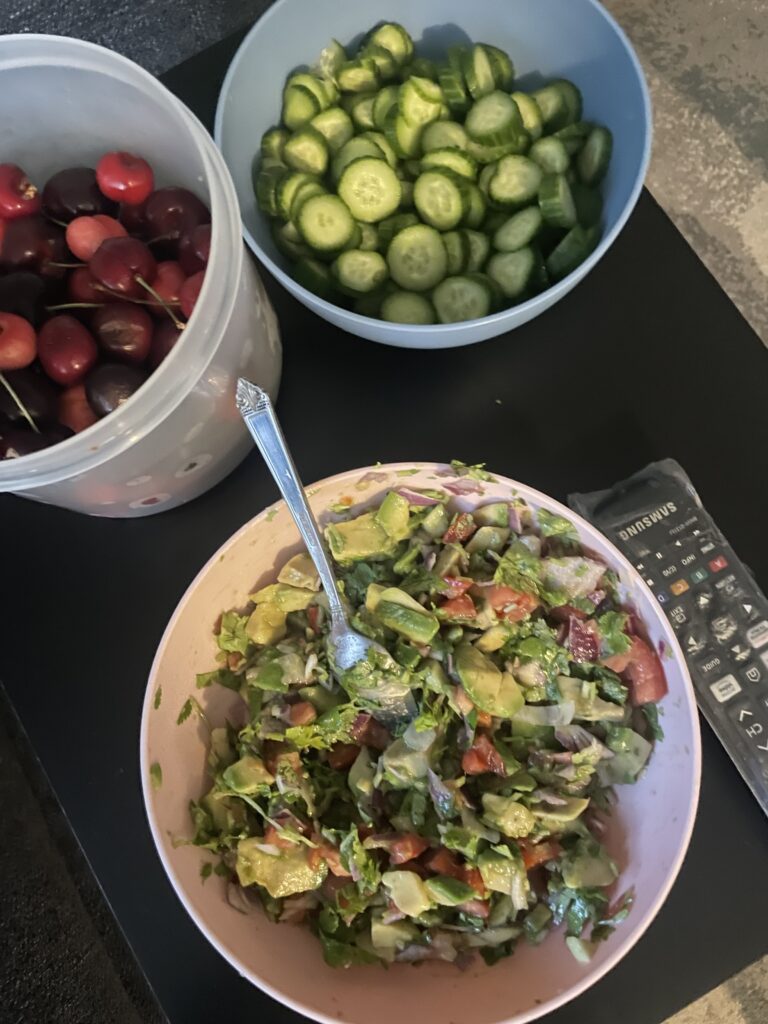
The salads I started eating at the beginning of high school often included chicken for protein, along with a dressing with an oil-vinegar base, often in a 1:1 ratio. That type of salad is a rather basic one, and many don’t just stop there, going on to add cheese, nuts, dried fruits, seeds, or other additional forms of protein and fat to enrich the salad’s flavor and texture to make it more interesting and enjoyable. However, these modifications can also go the opposite way, by filling a salad with additional low-calorie vegetables and fruits with a dressing sans oil. This is the type of salad I began to consume every day for lunch in the middle-latter part of my sophomore year of high school, which coincided with NYC public school shutdowns due to the COVID-19 pandemic. I started eating these salads because I decided that I wanted to be “healthier,” which for me meant losing weight, which I planned to achieve by eating less calories, being more active, and getting stronger through weight training.
I’ve noticed that at increasingly more restaurants, especially sandwich shops, you can salad-ify what would typically be a sandwich. For example, Bob’s Sub, a longtime family favorite sandwich shop in my mother’s hometown, added a section to its menu (which was otherwise solely sandwiches), called “salads.” The tagline associated with the “salads” section boasted: “you can now turn any of our delicious sandwiches into a salad!” This confused me at first glance, wondering how the bread and condiments would transfer over, which was a bit silly. But it meant exactly what you might think: instead of all the toppings going atop a freshly toasted hoagie roll, the toppings get chopped up and placed over a mountain of iceberg lettuce (arguably the worst salad base). Meat, cheese (both of which were optionally omittable, which would drastically reduce the salad’s total calories), tomatoes, black olives, banana peppers, onions, and whatever else was on the sandwich, condiments aside, were transferred from their usual resting place of the fluffy white sandwich bread onto the cold, sometimes unsettlingly wet, lettuce. I want to highlight here that in the tagline, “delicious” is attached only to the noun “sandwich,” and not “salad.”

Why would anyone go to the iconic Bob’s Sub and Sandwich Shop and not get a sub? I would. As a teenager struggling with body image issues that were fast developing into anorexia nervosa, my heart leaped at the thought of being able to deny myself the pleasure of soft, white bread and to instead fill my belly with a substitute that satisfied my disordered thinking, but not my appetite. The salad did curb my appetite for a little while, as the large quantity of lettuce took up much of my stomach’s space, but after an hour or so, after all the lettuce broke down and provided me with little to no calories, I felt myself longing for the satisfied feeling that I had always experienced after past Bob’s Sub lunches.
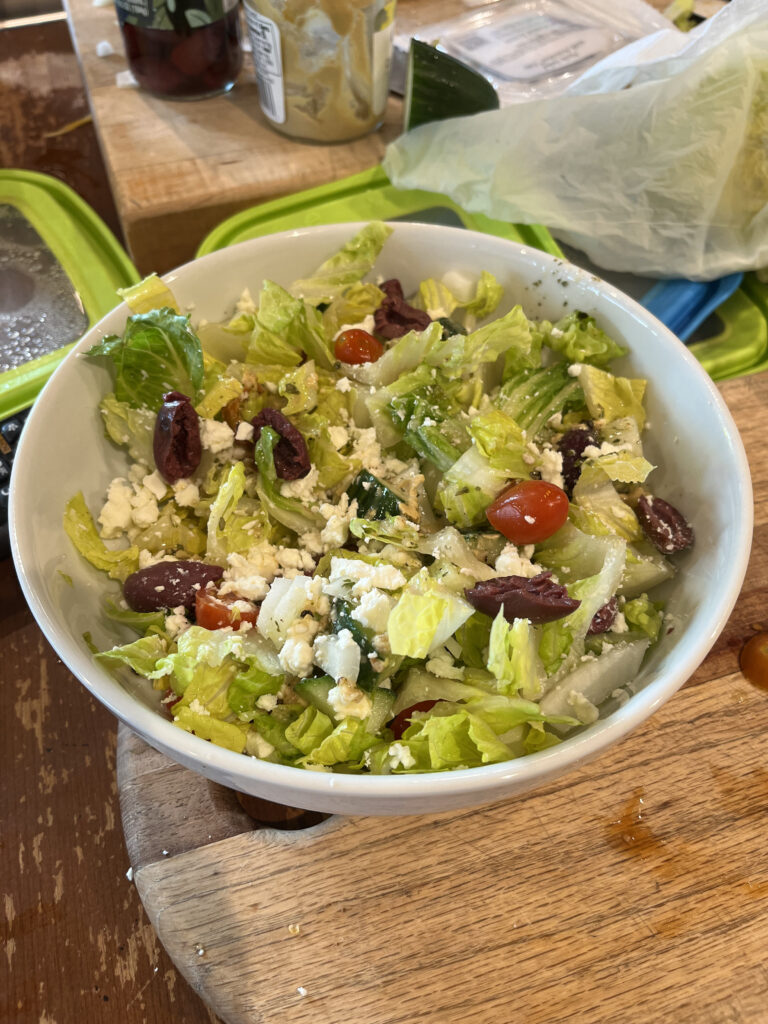
Salads can be nourishing, and they can be a part of a healthy, balanced, and non-disordered diet. But I was using salads as a filler—a dish in which I could maintain the flavors of my favorite sandwiches and pasta dishes, but without the calories. Salads became a part of my everyday life during sophomore and junior year of high school, and part of senior year as well even as I eased into recovery. My eating disorder told me I had to eat salads, and I had to like it. But how could I keep that going when the salads I was eating were unsatisfying, and left me hungrier than I was before? Because my eating disorder had become stronger than my desire to nourish myself. I refused to use any sort of oil in my dressing, instead opting for vinegar and spices mixed with mustard, hot sauce, a bit of non-fat yogurt (to mimic a tzatziki of sorts), or even sometimes, just vinegar alone. I never added cheese or nuts, and my protein was always lean deli meat, (often turkey), or chicken breast. The rest of my salad was chock-full of vegetables, their bright colors tricking me into believing that this “meal” was well-rounded and nutritious. Nutrients it had, but substance, craving-quenching, and satisfaction it lacked.
I forced myself to eat these salads day after day and for a while I truly believed that I loved them. Until I stopped eating them, on doctor’s (and my mother’s) orders. The next time I had a salad, just a simple side salad to a main meal during the summer after my senior year, I felt disgusted. I had force fed myself salads so much so that I had lost any appreciation for them that I might have had at the beginning of my salad journey, and even more importantly, I conditioned myself to associate it with my eating disorder, which still lurked in my brain, waiting for me to allow it back in to my frontal cortex.
For a while I avoided salads, opting for other safe foods that helped me feel in control, while also slowly upping my calorie intake for physical health reasons, which eventually turned into mental and emotional health reasons when I got further into recovery.
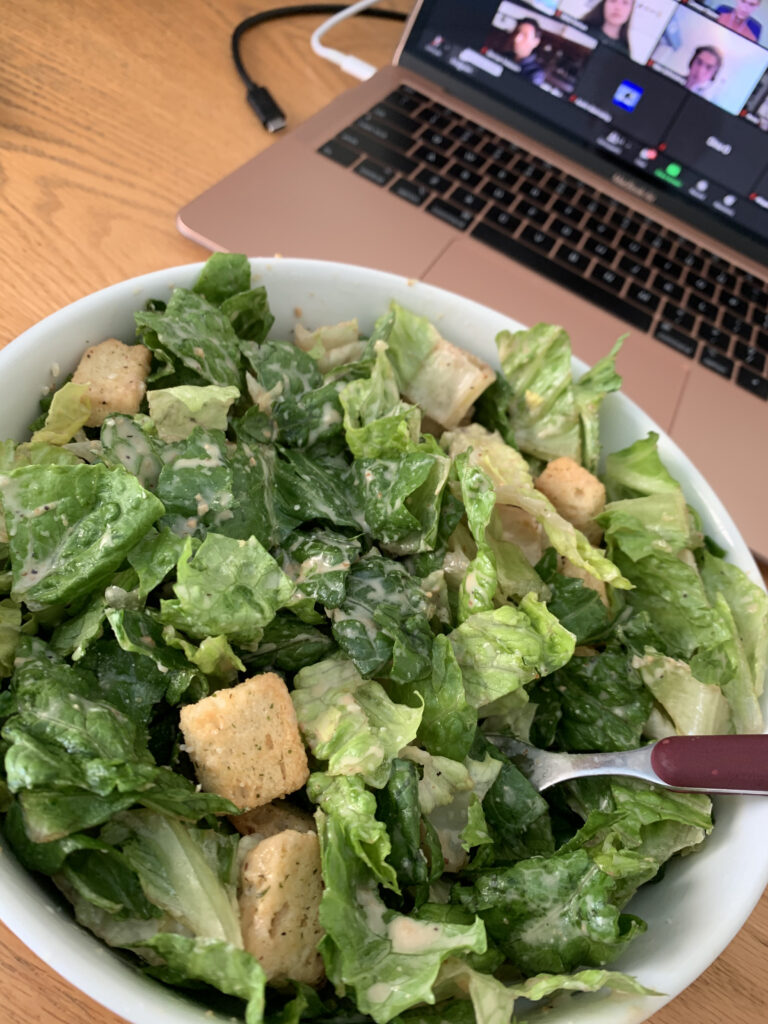
Caesar salad brought my love of leafy greens tossed in savory dressing and topped with crispy toppings back to life. The caesar salad is incredibly simple, and yet it contains all the aspects of a truly well-rounded and nourishing salad. Crisp lettuce and tomatoes for vitamins, minerals, and color, parmesan cheese for calcium, fat and saltiness, chicken for protein, croutons for carbs, crisp and crunch, and that heavenly dressing for more healthy fat, umami, and happiness.
I present here a recipe for caesar salad, representing my revised conception of a “healthy” salad. Sure, a caesar salad may have some saturated fat, and it doesn’t contain the rainbow of vegetables that my disordered salad did, but what the caesar salad provides is a feeling of satisfaction, which is the body’s way of telling you that you have enough energy to keep going. And for me, a lover of the salad, it hits the spot—it’s filling, salty, crunchy, cheesy, and it reminds me that salads can indeed be nourishing.
1. This addition of “reported” is important because many eating disorders, like illnesses, go unreported due to a lack of information, lack of access to medical and psychiatric care, and stigma. The ten percent I refer to is the percentage of US citizens that have an eating disorder in their medical record, but this percentage fails to capture the people with eating disorders who live their lives without adequate medical and psychiatric care, which is often due to socioeconomic and racial inequalities.
Caesar Salad with Mr. Esch’s dressing
Gregory Esch, or Mr. Esch, as my sibling and I have always called him, is one of my father’s closest friends. He is an eccentric man with a true passion for food and flavor, and who loves to experiment with growing and cooking food. Over the summer after my senior year in high school, we visited him, and he made us a variation of this salad. Now, I’m not entirely sure if this caesar salad was the one that rekindled my love of salad, but it certainly was a memorable one, especially his homemade dressing, which he insisted I help him make. When I conceived this project, I knew I needed to ask him for his recipe. He is a very important person in my life, as someone who always reminds me to love and appreciate good food.
Salad Ingredients
– Two handfuls of romaine lettuce, ripped or chopped into bite sized pieces
– Half a cup to a cup of grape tomatoes, kept whole for the explosive bite
– (Preferably fresh) shredded or shaved parmesan cheese (about two tablespoons, or more if you’d like)
– As many croutons as your heart desires (or approximately 1/4 cup)
– Simply seasoned (to your taste) grilled chicken, sliced (this can be substituted with a vegan/vegetarian protein of your liking, like grilled tofu or hard boiled eggs)
– Salt and pepper to taste
Directions: Add lettuce, tomato, croutons, and chicken to a bowl. Top with shredded/grated parmesan cheese. Sprinkle salt and freshly ground pepper (freshly ground makes quite a difference if you can manage it! Freshly ground guarantees the flavor of the pepper to be fresher and provide more of a pronounced bite than pre-ground pepper)
Dressing ingredients (note 1: Mr. Esch’s dressing is very much based on personal preference. He suggests eyeballing everything, tasting and adjusting as you go, but I added some measurement guidelines for readers who prefer precision. Note 2: this recipe is for a batch of dressing which serves about four people, so you’ll have leftovers [and you won’t be sorry])
– Extra virgin olive oil (about ½ cup)
– Anchovy paste (about 1-1 ½ teaspoons)
– 1-2 (depending on taste) clove(s) garlic, cut into slivers
– 1 egg yolk
– A bit of water (approximately 1 tablespoon)
– Lemon juice (optional), about 1 tablespoon
– Salt and pepper to taste
Directions: In a food processor, add (some) olive oil, the egg yolk, and water, and allow the processor to emulsify the mixture. Add about half of the anchovy paste and garlic, along with salt and pepper (a pinch or two of each). Blend, and taste. Keep adding more of each ingredient based on whether you want more salt, umami (provided by the anchovy and garlic), spice/kick, or sour (consider adding lemon juice to up the sourness). The turning point (and stopping point) comes when the olive flavor of the oil is subdued behind the umami flavor from the anchovy and garlic. Toss approximately 2 tablespoons of the dressing with the amount of salad listed above, until the salad is coated in dressing but not saturated—the leaves should still have some structure (and thus, crunch) to them, but not so much that there are a good deal of leaves that do not have any dressing on them.
When I was coming up with a concept for this project, I had a lot of things swirling around in my mind, ranging from Russian borscht to homemade dumplings to celebrate Têt, or Vietnamese Lunar New Year. I started writing about each idea, trying to see which one felt right. But I kept coming back to the calorie: the very concept that drew me to food studies in the first place. Besides my personal connections with the harmful effects of calorie counting and disordered eating, I have a great deal of academic interest and prior research experience exploring the discrepancies across the health of Americans, and the ways in which colonialism and capitalism tell us what we need and don’t need nutritionally. Our reading about the colonial nature of the calorie, “American Pie: The Imperialism of the Calorie,” by Nick Cullather, really resonated with me as a political reframing of my personal and research informed-thoughts about the misleading metric of calories. Calories are a colonial invention initially intended to quantify groups of people in a way that made it easier for the state to surveil them, especially during a crisis, as referenced in “American Pie” in regards to American rationing techniques during World War I and the rhetoric used when providing aid. Though my argument surrounds a more contemporary example, calories are still used as a method of control and regulation, and are closely tied to an individual’s value, similar to how rationing became a meritable and patriotic act during wars (Cullather, 2007). Particularly affected are young people, who are susceptible to propaganda circulated by weight-loss companies, social diet culture, high-visibility and highly-respected figures such as supermodels, as well as government guidelines about daily calorie consumption, nutritional needs, and “normal” weight values given height or age.
An important thing to remember about the calorie, however, is that it’s understanding in the American context is derived from an isolated study done in 1896, by Wilbur O. Atwater, a scientist who performed the experiment at Wesleyan University upon a student, A. W. Smith (Cullather, 2007). Smith was sealed inside a chamber that functioned as a calorimeter, measuring his energy intake and output while providing him with set amounts of food and putting him through strenuous mental and physical tasks (Cullather, 2007). This machine became the cornerstone of our modern understanding of nutrition, but important drawbacks to the experiment are important to mention. Smith was a young white man, and by no means representative of the vast diversity of bodies that make up the human race. Atwater’s calorimeter gained national attention, and became central to the understanding of how the human body produces energy. The fact that the calorie is a Western male construct gives it power through dominance and an authenticity derived from colonialism and American exceptionalism which erases the vast variety of bodily differences that exist in the human race. To make the body’s production and utilization of energy something universal and factual is an oversight, and reflects a colonial goal of determining and universalizing what any one body needs based on a Western standard. And that goal came to be. The conception of the calorie based on Atwater’s study became an international metric, which positioned America as the authority over nutritional science, to which all other nations would be compared with. The calorie made it so that foods could be compared across a single quality: energy.
The way we view the calorie now, in the twenty-first century, is far different from how it was viewed in the war-torn time period Cullather was discussing. In the context of wars, calories should be maximized while volume is minimized, as high-calorie foods will keep you full for longer. But due to diet culture and the privilege of the Western world, where we have access to an excess of calories, a new goal, minimizing calories while maximizing the volume, has become like second nature to those affected by Western standards of beauty, particularly women and girls. Like many aspects of colonial power and biopower, (Foucault’s concept of the way that the government (or the state) surveils and controls the bodies of its subjects), we are often unaware of just how ingrained the calorie is in the way we think about fueling ourselves. The calorie is a tool of biopower, and the messages all around us about calories may be shrouded in ideas about improving health and managing well-being, but the colonial intention remains—to regulate bodies while maintaining the guise that we are independent. As an example, I turn to the phenomenon of salad chains, places like Sweetgreen and Just Salad. Despite the fact that at build-your-own style restaurants we appear to have our own agency in choosing toppings/ingredients, the fact that calories are posted for every ingredient represents a colonial remnant of wanting the consumer to be aware of their caloric intake and to associate personal value with caloric intake. Although we in the US are not in a food crisis at the moment, there is still a sense of patriotism that comes with minimizing caloric intake, thus not over-indulging. On the other hand, Western diet culture associates value with body size, and body size with caloric intake, so by being constantly reminded that our value is related to our caloric intake, design-your-own salads provide the consumer with a way to control that. Because of the pervasive influence of diet culture, this option often results in the consumer desiring to minimize the amount of calories they intake in order to reach the ideal body shape, which for women is slim, athletic, (without being bulky), and yet naturally curvy, while for men it is about having lean muscle mass, which is associated with caloric maximization of protein and minimization of fat. Even if someone doesn’t think of themselves as someone who cares about calories, the constant presence of them causes calorie rhetoric to infiltrate our decision-making. This constant exposure to calories can lead to an obsession over calories, such as calorie counting/tracking, which is an express train to disordered eating.
Another aspect of analysis in my recipe is the politics of taste, individually and externally. Zadie Smith’s article “Some Notes on Attunement,” resonated with me in the way that she recounts changes in her personal taste. Smith’s article is a detailed account of her taste in music, and how it changed over time and space, centering around how she eventually came to reverie Joni Mitchell, whom she used to detest when she was younger. This change and adaptation of taste reminds me of my own relationship with salad. I started with thinking little of salad; it was nothing to me but a vegetable, and not one I would choose to eat. But over time, as the messages from the world around me began to infiltrate self-perception, my taste began to change by virtue of perceived necessity and salads became my everything (though Smith’s change in taste feels more natural and unknowable, she too was affected by outside influences, such as her friends and her husband, before coming to her own conclusion about Joni Mitchell). But my love for salads was manufactured as a sort of coping mechanism to deal with my body image issues, and not due to my own coming-to-terms with salad and its benefits. Due to overexposure, my taste changed again and I was disgusted, even nauseated by salads—a visceral reaction to forcing myself to like salads, much like how Smith’s constant pressure from her friends to appreciate Joni Mitchell only seemed to enhance her hatred for Mitchell’s music. Eventually, after recovering, I came to terms with salad as a vessel of nourishment, depth of flavor, nutritional variety, and exciting textures, because I was finally able to appreciate a well-balanced salad without the looming presence of my eating disorder over my head. When Smith had grown up and learned more about herself as an individual, she finally was in a place where her sans-Joni Mitchell upbringing and anti-Joni Mitchell adolescence no longer had a hold on her, which allowed her to finally appreciate the music on her own terms.
Re-discovering caesar salad has allowed me to appreciate salad in my own terms, rejecting the politics of the calorie and weight loss in favor of nourishment. This is not to say that Caesar salad holds the potential to change the way one thinks about food, but the dish reminded me that food serves not only the purpose of fueling the body, but also provides us with pleasure. Recovering, which heavily emphasized rejecting diet culture and turning a blind eye to calorie counts, gave me the ability to find pleasure in salads once more, as a vessel of enjoyment rather than a tool for weight loss.
Sources Cited
Cullather, Nick. “American Pie: Imperialism of the Calorie.” History Today 57, no. 2 (2007): 34-40.
Frigolet, María-Eugenia, Martha Tamez González, and Victoria-Eugenia Ramos Barragán. “Low-Carbohydrate Diets: A Matter of Love or Hate.” Annals of Nutrition & Metabolism 58, no. 4 (2011): 320–334. https://www.jstor.org/stable/48514136.
Smith, Zadie. “Some Notes on Attunement.” In Feel Free by Zadie Smith, pp. 100-116. New York: Penguin Random House LLC, 2018.
Ella Bezkorovainy, OC’26, is a Comparative American Studies and Dance Major from Brooklyn, NY. Ella has a particular interest in the intersection of food studies, fatphobia, diet culture, and colonialism, as well as exploring intersections between the performing arts and culture studies.
