Edited For Clarity by Shira and Al
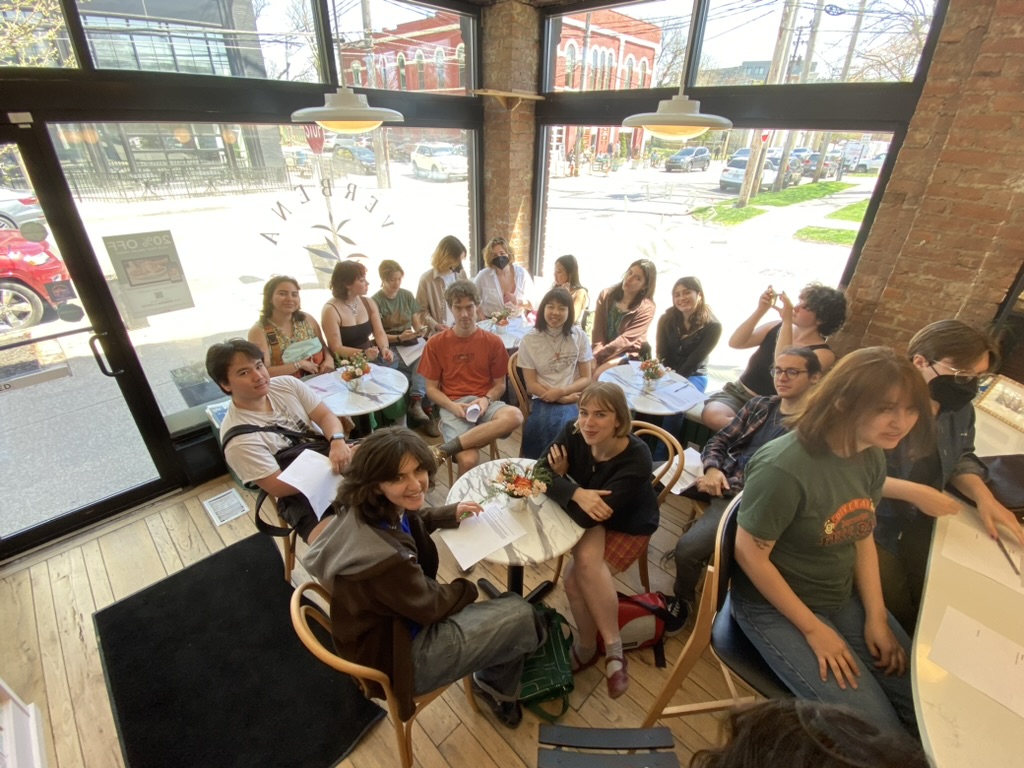
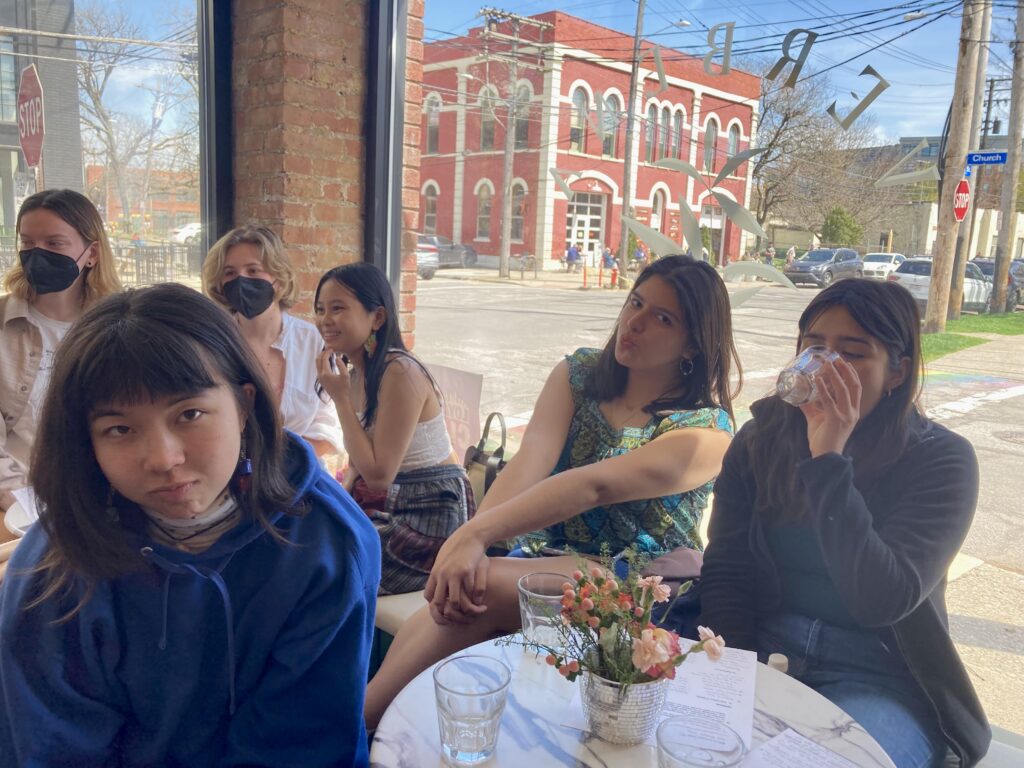
Our class took a field trip to Ohio City to visit bars and restaurants in the Near West Side neighborhood, controversially rebranded and redeveloped as Hingetown in recent years. Our first stop was Verbena Free Spirited Shoppe, a nonalcoholic bar and retail shop opened by Molly Cheraso in July of 2023. At the time of this conversation, they’ve been open for about nine months.
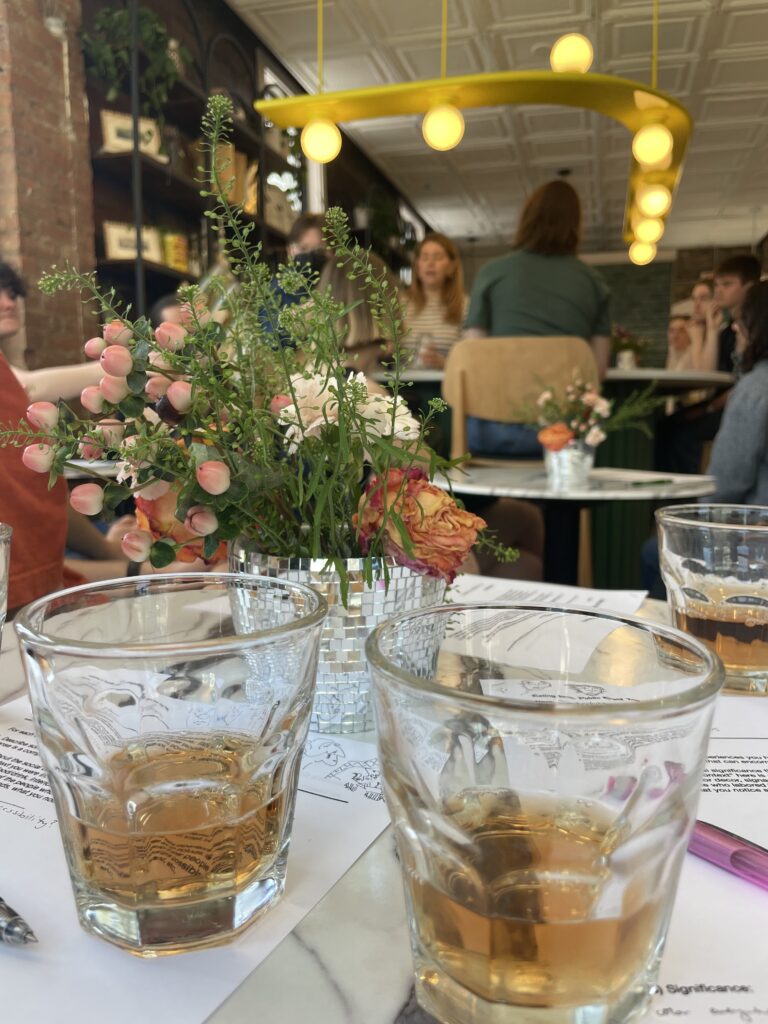
As a nonalcoholic space, Cheraso runs Verbena a little differently than traditional bars, including a visually-driven display of nonalcoholic retail options. The space is bright and colorful, with a feminine energy and botanical motifs. As we spoke with her about her business, Molly Cheraso served our class three drinks: a Faux Rosè, a “New Fashioned,” and Leilo’s canned kava beverage.
What was your background pre-Verbena? How did you get into the nonalcoholic beverage scene?
I had an accounting undergrad degree. I worked in public accounting and then in internal audit at KeyBank. I had a very corporate career for the first 17 years after college. All of that really changed for me during the pandemic, when a few things shifted.
The first thing was, obviously, I went from working in an office to working from home full-time, and so did my husband. We started using alcohol as this marker at the end of the day, as a ritual of, “Okay, we’re still home, but we’re not in work mode now, we’re in home mode.” I think that happened to a lot of people. In 2020, I would say we drank more alcohol than we had previously.
Starting in 2021, my husband did something called Dry January. He was also training for the Cleveland Marathon. He was running better, sleeping better, feeling better. He decided to see if he could incorporate that into his life. Fast forward to now, he still does not drink alcohol.
At that point in our life, we’d been in a wine club. I was going to this local wine shop to pick up wine bottles and I started seeing NA (nonalcoholic) options. The first option I saw was a brand called Seedlip. The NA beer options were really good, and that’s really what started to hook my husband in.
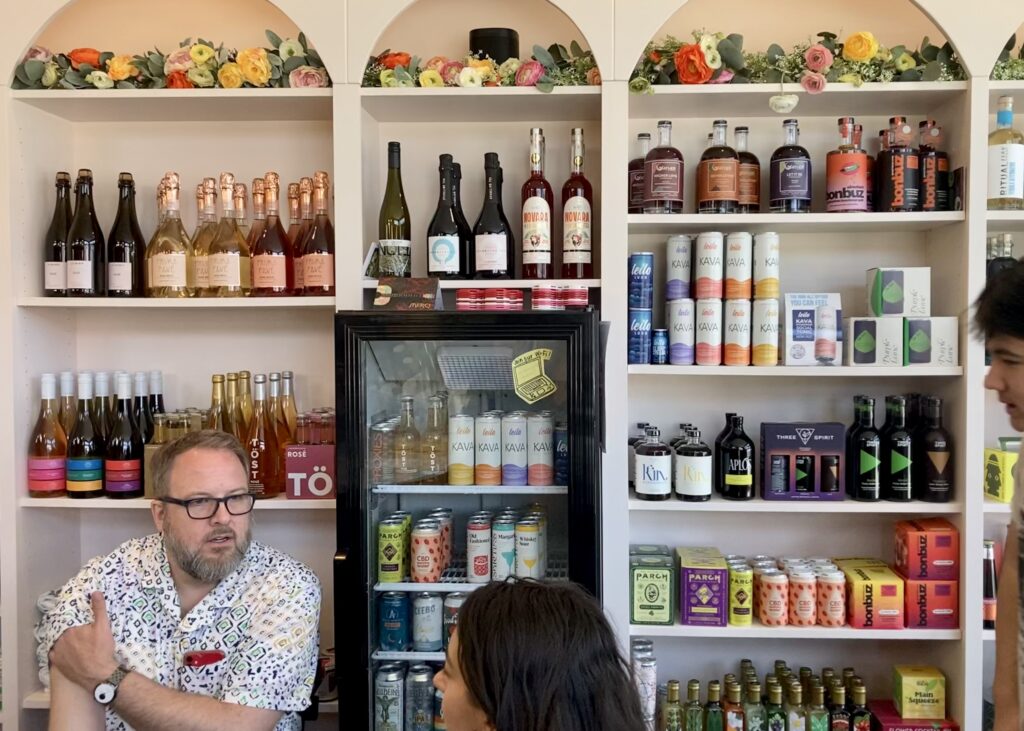
And then the Instagram algorithm figured out that I was interested in NA products. It just so happened that that timing coincided with the fact that the NA market as a whole was completely changing and it was being really flooded with new products. A lot of those products were using Instagram as their main channel of marketing. If you look at the wall behind you, you can kind of see they knew they needed to package themselves beautifully. The majority of the products that we sell now are not more than three years old.
They’re very new. For the most part, they’re small businesses, small makers that are just getting started and have a passion. They know they need to have great marketing and great packaging that draws you in, intrigues you, entices you. That really worked for me. I started ordering everything I could off of Instagram.
We found there were some really, really great options available. It was no longer just an O’Doul’s beer or a really sugary sweet wine or juice. We got so excited to keep trying all these great new products.
So we get to the end of 2021 and at that point I was really feeling over this corporate career. There was really just no creativity in it. The aspect I’d always liked was the people, the leadership, and the management. Now that we were working from home, so much of those interpersonal aspects were lost.
What motivated you to open a nonalcoholic bar in Cleveland?
I was working with a career coach at the time and just said, I’ve always wanted to open my own business. Right around the time I was working with her, I read about Spirited Away. Spirited Away takes credit as the first NA bottle shop in New York City. So picture what I have here, but a whole store. It’s like a liquor and wine store, but everything they carry is nonalcoholic.
I read about that in December of 2021. It was still peak COVID. I couldn’t travel to New York City. I was just wishing I could go there and talk to somebody who was knowledgeable about all these things. I wanted to sample something. I wanted to see it all in one place and I couldn’t do that. And that was my “aha” moment, I wish we had that here in Cleveland.
And why couldn’t I do that? So I took 2022. I kept my day job, but started doing pop up events around the city to try to feel out if this was something other people were getting into. I really had no idea at that point. I didn’t know a lot of people in my life that were willingly thinking about changing their relationship with alcohol.
It’s always been approached as this all or nothing thing: you either have a problem and you have to stop drinking; but if you don’t have a problem, you should be drinking. If you’re not drinking, you’re going to get questions and a lot of pressure. It’s this very social, cultural thing. I didn’t really understand that at that point. The term sober-curiosity is sort of out in the zeitgeist. I wanted to see if that was something other people were thinking about.
So I started out on a journey in 2022, going to events, taking the products, sharing them, meeting people, hearing their stories. And really that’s what encouraged me to continue to pursue this. Because I heard so many stories of people that don’t drink. Maybe they just stopped drinking, but a lot of people haven’t drank for a long time. And that wasn’t something they were typically comfortable sharing socially. Some people aren’t drinking because they’re on a medication. They have religious restrictions. They just don’t like the way it makes them feel.
I got a lot of people that just wanted to tell me about it because it’s not something they felt like they could openly talk about. It’s an interesting pressure that our society puts on people.
But long story short, I did all of these events and ultimately decided that there was enough of a market. I felt like this was a movement that was going to get bigger and bigger, and something that I was willing to risk it all on, go all in, and see what I could come up with.
And then where I got really, really lucky is I did an event in January of 2023, at the City Goods, which has a collection of different artists and makers that sell their stuff there. I did an event there. It was the first Saturday after the holidays. There should have been no foot traffic. There should have been nobody there. But it was the best event I’d ever done, and I discovered that this is a destination neighborhood in Cleveland. Ohio City, and especially, this little part here, which we call Hingetown, which felt important for me because I really needed to be drawing from a large swath of the city.
I only told one person, “Hey, if any leases are coming up in this neighborhood, I’d be interested.” And within a week I got an email from Amber, who was the previous owner of the last business in this space, which was called Cleveland Tea Revival. Cleveland Tea Revival still exists, but it’s all online.
She was looking to wind down her brick and mortar space, and that was exactly what I was looking for. We had one conversation and felt the tea pairing was perfect. So I purchased her brick and mortar business, which included most of the equipment you’re looking at now, her menu, her food license, her lease, all these things that made it very easy for me to get going very quickly. And she trained me, I had no food service experience. I hired people, she helped train them. We had this great foundation of an existing tea shop cafe, and we built on top of that.
We still keep their menu almost largely the same during the daytime. And then at three o’clock we transition and open the bar. The bar has a full cocktail menu. We change it seasonally and we’ve got appetizers and great food. And everything we use is also for sale in the retail part of the business.
We also do a monthly book club here. I try to do a lot of community engagement things. One of the first books we read was Quit Like a Woman by Holly Whitaker, which I actually sell. That book was really eye opening for me because she talks about Big Alcohol in the same way as Big Tobacco. I’d never realized all that cultural pressure I mentioned was not necessarily organic.
It’s on purpose, and Big Alcohol has spent a ton of money on marketing and advertising to everybody what alcohol is. It’s how you have fun, so people really think alcohol is the purpose and the source for fun. It can be very sexy. It can be romantic. It’s taken over celebrations. You can’t have a celebration without a bottle of champagne. Even if you’re having a baby, it’s like, “Bust open the champagne.” And then sporting events––you run a marathon, what do you get at the end of the marathon? You get a beer.
I’ve done so many yoga events where, after, we’re going to sip some wine. I’m a 40 something year old woman, and this mommy wine culture has really been pushed down on us, like “Moms need wine to unwind. You need to relax. You need your wine.”
It’s not an accident. Big Alcohol has spent a whole lot of money to get all that out there. It’s great for their sales.
That’s the difference with a lot of the products that I sell. A lot of these are really small makers and they’re using really high quality ingredients. They’re making things in very small batches. The owner was just here last week. It’s not all of them––some of them are now owned or developed by larger alcohol companies who are finally coming around to this as a change, and realizing that people are heading in a different direction.
One of the big distinctions in nonalcoholic beverages is there’s drinks trying to mimic traditional alcohol, and drinks not trying to mimic traditional alcohol. I call them functional spirits. They’re putting in different ingredients like adaptogens or even caffeine, supplements, kava, things that give you a mood, effect, or a feeling. You can use them like you use alcohol, you can make a drink with them, but they’re not trying to taste like tequila.
Within the grouping of products that are more mimicking traditional alcohol, there’s also a deviation. Half of them are alcohol removed. The best tasting nonalcoholic wines start with wine and then they take the alcohol out. Or, for whiskey, they make a quick whiskey and then they take the alcohol out. It smells like the real thing, it tastes a lot like the real thing. But not everyone wants that.
The other portion of products mimicking traditional alcohol are not dealcoholizing. They use different blends of herbs and juices and extracts equate with the flavor of alcohol. That’s what this woman did. It’s called Faux Wine. She starts with a product called Virjuice. It’s unripe grape juice, so it tastes like grape juice, but it’s super tart and gives you that tannin-y thing you expect from wine. And then she mixes a bunch of extracts with it to come up with something that tastes a lot like rosé.
First drink: Faux Rosé
Ingredients:
Water
Verjuice (unripe grape juice)
Pinot noir concentrate (so they do use the wine grapes)
Apricot concentrate
Peach concentrate
Apple concentrate
Raspberry and other natural extracts
This was Al’s favorite out of the drinks they sampled.
What’s the process for dealcoholization?
That’s a good question. It’s also one that I don’t have a great answer to because it’s considered proprietary information. It’s the secret sauce for a lot of these companies. They’ll say words like reverse osmosis, triple distillation, additional filtration.
What are busy hours here? Are people coming in for a drink after work, or going out for drinks here?
Because we were an existing tea shop cafe, we do have a lot of people that come work here during the day, like a coffee shop. We do ChowNow (an online food ordering platform), we have a great rice bowl, people will order that for lunch.
The bar is open Wednesday through Sunday. Our busiest nights are Friday and Saturday; we get a lot of people. There’s some good restaurants in the neighborhood, so some of it is people coming to grab a drink before they go out to dinner, or a drink after.
We get a lot of pregnant women, or people that want to go out and not have to worry about the pressure of drinking. Like date night. It’s sort of what you would expect at a cocktail bar.
What are some of the most popular orders from the bar?
We have something called a new fashioned, which is our take on an old fashioned. That’s the one that uses this dealcoholized whiskey. We also have a lychee margarita that’s really delicious.
But where I see the future of it going is really more the functional route. A lot of people stop drinking because they don’t want to feel bad, but then they’re like, “What can I do to feel even better?”
So that’s where the focus is. They’ll give you an effect, and some of them have B vitamins. They’re just so good for you.
Do you find that most of your sales come from the bar or the shelves?
My original concept was just to do retail because that felt feasible. Until I met Amber. The margins in restaurants are very small. I was surprised by the amount we get in retail sales, but I do think that having the bar leads to a lot of sales. People need to try this stuff first.
I stopped drinking in 2022. At that point, I wasn’t drinking very much anyways. So I’m two years into not drinking and my palate has completely changed. If you give me regular wine, I lose all the subtlety. All I can taste is ethanol. Anything with a cocktail just tastes like ethanol. It’s like rubbing alcohol, like I have reverted back to a very childlike palate. But also, I tell people that because these drinks taste better when you haven’t been drinking alcohol, because you’re not expecting that.
We do try to get that burn of alcohol. A lot of times we’ll add ginger or pepper or tea, things that’ll give you what your mouth is expecting from an alcoholic drink. But they do taste better if you don’t drink alcohol, the longer that’s been out of your system.
I do have a really great dealcoholized red wine, with that one, I always tell people to ignore the first sip, the first sip is bad. But it builds on your tongue, the same way I think wine does. As you drink it, it gets better and better and better. It builds a layer on your tongue.
Do you do any catering or events?
I do events. This past Saturday there was a local fundraiser, and I brought drinks and served that. I only just got on my website that we’re offering private events but those are in the store, in this space. There’s another person who just came to me and said she wants to start more of a catering, mocktail, bartending event service. So maybe if I do get requests for that.
I haven’t done any weddings. I’ve gotten asked to quote out a wedding and it’s sort of too big of an undertaking and I don’t have all the equipment for that. So I’m sending them to her right now and I’m also trying to figure out if there’s a way she and I can more formally work together going forward, because we want to collaborate versus trying to compete in this small space.
Were things crazy busy in January?
Yes. Things were crazy busy when we first opened. It was also the middle of the summer, and this neighborhood is alive and crazy. I mean, it’s great all year round, but especially in the summer, it’s just packed. Then we kind of had a little dip in the fall.
The holidays were great. A lot of people were buying gifts and wanting wine with their Thanksgiving or Christmas dinner. And then January was fantastic. So many people came who were doing dry January. But then we had a dip in February and March. I’m still learning the seasonality. As the weather’s gotten better, it’s started to pick back up. It’s so weather related.
A lot of bigger brands have just started making nonalcoholic stuff. You’ve mostly got products from independent brands. What’s your process in choosing what to sell?
I’ve tasted a lot of things that I hate, and if I don’t like it then I’m not going to sell it. The best sales for these happen when people come in and they want our recommendations. If we have it open you can try it. If we don’t have it open, you’re gonna kind of be taking my word for it. So it has to be something I really like.
I have such a small space, I only want to be offering things that I know you can’t get elsewhere. If you can get it at the grocery store, I’m not gonna use my limited shelf space for it.
A lot of the decor feels very feminine. Was that a conscious decision? Does it reflect who you’re hoping will come into this place?
Like I said, I came up through banking, which was very male-dominated and patriarchal. I wanted to get as far away from that as I could. So when I had the opportunity to do it my way, when I was working with the branding people that made my logo, I told them, I want it to be lush, botanical, feminine. With the interior, too, we were going for those same words, lush, botanical, feminine.
I want the whole space to feel very inclusive. I want everybody to come in and just feel cozy and comfortable. I’m a woman and a mom, and I want you to be able to come in and feel like you can just sit down and talk to us about whatever.
Everything we do is pretty feminine, I guess. I’m lucky if we get a man to come to anything.
Second drink: New Fashioned
Kentucky 74, a dealcoholized whiskey
House-made ginger syrup (gives it that burn in the back of your throat)
Nonalcoholic orange bitters
Garnished with a maraschino cherry and an orange
This was Shira’s favorite out of the drinks she sampled.
How popular are nonalcoholic beers and wines versus cocktails?
I knew when I opened the biggest challenge was education. People just don’t know, and a lot of people still don’t know. I’m doing whatever I can to get people in and just try it out. The wine and beer are definitely more commonly known. The spirits are growing. A lot of restaurants will have nonalcoholic cocktails.
One of the main questions we get when people come in is, “How do I use this?”
I don’t want to send anybody home with a bottle that’s just going to sit there because they don’t know how to use it. So we’re very free with our recipes, and our recipes are generally pretty simple. I also always recommend people to go to the website of the brand, because they’ve had the most time to play with recipes and come up with stuff.
But if it’s a whiskey, tequila, or gin alternative, you can use it the same way you would traditional alcohol. It’s the other ones that have a different flavor profile that can be more difficult to do that with.
Are people coming here typically nonalcoholic already, or do you have people who do drink alcohol trying stuff?
Both. People come in for a really wide range of reasons. Some people have gone through recovery and are formally sober. But an AA program does not recommend that you come to a nonalcoholic bar, or any bar. They don’t recommend you try to substitute with any product. And then there’s just a lot of people that are curious and wanting to try it on for themselves.
Between the functional nonalcoholic drinks and the alcohol-mimicking drinks, what do you find is more popular?
Mimicking traditional alcohol gets people in the door, because it’s what they’re more familiar with, and comfortable with, but I really think the future of the industry is in the functional space.
The experience I’ve had, and that many people have had, is you stop drinking alcohol, you go out, and you are like, “Oh my gosh, I’m still having fun, and I still feel buzzed. Where’s that coming from?” Then you wake up the next morning, and you can wake up early, you feel great! People are surprised, “Oh my gosh, I had fun and I don’t feel bad.”
I think the next step is functional drinks that make you feel extra good. Those products are going to continue to get better and better. I don’t know how that will overlap with the legalization of cannabis. I do think there’ll be some stuff there. People are going to want to continue to optimize and use these functional products to enhance their life. I don’t miss drinking alcohol at all.
Third drink: Leilo’s Kava Social Tonic (Canned, 4 flavors)
Kava is a root from the Pacific Islands used medicinally for thousands of years
Gives the drinker a feeling of relaxation
These drinks had a strong stevia taste
What’s the business attitude that you look for when you’re looking to partner with someone or get their product in the store?
With the brands I’m going to carry in the store, it’s mostly about the taste and if I like the way it makes me feel.
I get a lot of people offering me stuff. I say, send me a sample. I’m not going to sell it, send me a sample. Sometimes we taste it and it’s too weird. In terms of who I partner with, it’s really just, are they aligned with the types of things that I want to be doing? Is it something I would want to do and would think is fun? This is something that I think is beneficial. I want to create a community here. We have created a community here. There’s a lot of people that are starting to get really into this. You can tell when people have an enthusiasm for something that aligns well with you. It’s really more about, “Is this a good fit for both of us?” And if it is, let’s do it.
Is it mostly young people that come in, or do you have some older people that are working on trying to live a healthier lifestyle?
This neighborhood is fairly young. Young professionals are probably the largest customer base that comes in right now. There’s people that are around my parents’ age, people in their 60s starting to find their way in.
A lot of them are coming to it for health reasons. There’s a similar store in Carmel, Indiana that I’ve been connected with and their bread and butter is selling to the retirees that are members at the golf club. They’re buying nonalcoholic Chardonnay by the case.
The grumpy old husbands whose doctors told them they can’t drink whiskey anymore want an alternative. I’ve had people come in––sorry, old men––that say, “I can’t drink whiskey, what have you got for me?” and then I pour it for them, and they say, “Oh, I guess it’s okay.”
It’s a range.
How do nonalcoholic drinks compare to alcoholic beverages in terms of pricing?
For the small batch, especially the functional ones, they’re using these like super high quality ingredients, organic and well sourced things. Their cost to make it is so high. Our typical average wine, I would say it’s $26. Most cans cost $5. Most of the spirits are $30 to $40. It will save you money because you will drink less.
What helped my husband was that the NA beer is so good. If he was going to drink a beer he would drink an NA beer and first he was drinking a lot of NA beer, but that has totally tapered off and he doesn’t drink very much of it at all anymore. The NA beers taste so close to the real thing that you can just sub them in. Subconsciously. It’s more about the habit of it. It’s a ritual.
Do you have any difficulties keeping this place afloat?
The margins in a restaurant, in a nonalcoholic bar at least, are very thin. The retail is better, but it’s not like a wine shop where I’m selling wine by the case. So the margins here are very small. People told me not to expect to make any money in the first year. I haven’t been open a full year. I will say, it was a very expensive undertaking to get off the ground, so I did not turn a profit in 2023. My goal is to turn a profit or at least break even in 2024.
That’s part of what I’m still learning, too. My biggest expense right now is my payroll employees. I started out totally over-hiring, knowing that I would lose people. So we started out with a large team. We’ve kind of whittled down to a small team.
Right now, I’m working a lot. At first, I didn’t work any shifts. I was doing other stuff. Now I’m working a lot and trying to figure out what I want that balance to be. I do think to make money I have to physically work in the shop, so I’m not paying people all the time. But I can’t always be here. Wednesday, Thursday, and Friday are 12 hour days. I could not work all day. I’m still trying to figure out that balance.
I get pulled in a lot of different directions because the operations of the café and the bar are one thing, and then there’s a lot of other things I have to deal with on top of that. I do all the marketing, I do all the purchasing and making sure we have everything we need. It’s a lot of running to the store to get cucumbers. These things seem so small, but they’re time-consuming week to week. So I hope I have a different answer in a year, that I’m raking in the money. But right now, I’m not doing this for the money. If I was in it for the money, I would have stayed in my corporate job where I made a ton of money and hated it. It was soul sucking and I didn’t want to do that for another 20 years. Here, as long as I can pay for my life and keep going on, I’m so much happier.
