An Essay in the Style of Pinball♦
♦ This is where you will find my unserious thoughts… and a few very serious citations. Consider it a game of pinball where you, dear reader are the the ball bouncing back and forth between my writing (you’ll see why)
When I turned 21, I went to a bar.♠ It was fun because on your 21st birthday, drinks are free and you’re the center of attention. The next day, I went to another bar. I had less fun that time. In addition to paying $15 for a glass of rosé♣, I was probably the person in the bar who cared the least about the “fine wine” I was drinking. After a long day of living in the world we live in, I need an escape. But why are all these bars so damn serious?!♥ It was my dear friend Kotama who declared that “the point of life is to play,” and I carry this mantra with me. As a comedian and an overall unserious person, I try to find playfulness in everything, including my third places.♦ When my friends and I became legal drinkers, we started looking for “our bar.” The criteria for the bar was pretty simple; it had to be cheap, it had to have a smoking patio, and it couldn’t take itself seriously. In Los Angeles, a bar like this is hard to come by, but after a bit of searching, we eventually found our few unserious, but much needed, third places. Whether it be through its kitsch, games, pinball or karaoke, these third places serve as adult playgrounds for my friends and I to forget our troubles and build a temporary utopia of fun.
♠ Original, right? A freshly legal 21 year-old goes to the very establishment that believes she was 23 for four years straight.
♣ Minus tip!!!!
♥ And expensive
♦ Defined by sociologist Roy Oldenberg, third places are the home away from home and work where humans congregate and socialize
If you can believe it, there’s academic theory supporting my need for play! Johan Huizinga♠ published Homo Ludens, a seminal work on the theory of play, in 1938, during the rising tensions of pre-World War II Europe. Examining how culture is entangled in play, the theorist wrote at a time that is not historically deemed “playful.” Yet what he identifies as play and why it is important to humans forces a reimagination of play beyond the scope of child-like behavior. Huizinga understands the cultural phenomenon of play as an unserious activity that is “connected with no material interest, and no profit can be gained by it”.♣ It exists in the confines of time and place and serves as a form of escapism for players. While play can be fun, it can also be taken very seriously. Play is a voluntary form of escapism, functioning as “a stepping out of ‘real’ life into a temporary sphere of activity.”♥ Huizinga understands play as far more complex than a simple game. Rather, he understands the way play is utilized to build worlds, community, and sanctuary for a few fleeting moments.
♠ Try to pronounce that! (rhymes with bazinga)
♣ Huizinga 13
♥ Huizinga 8
Knowing that Huizinga wrote Homo Ludens at a time when fascism was rampant through Europe, it is significant that he understood play as a temporary escape. While writing during a serious and unprecedented time, playfulness was still relevant. I believe that the historic context of Huizinga’s work is significant in and of itself. Play can be a radical act of resistance through escapism. It does not ignore the woes of reality, rather it imagines a world beyond. While I am not writing from a war-torn Europe, I am still in dire need of escape. Adult life is often not easy, and the political and environmental climate we are living in only makes the hard things harder. Until the revolution happens, it seems escape will always be a cultural necessity to imagine a future, better world. In a modern context, this escape can take many forms, particularly the digital. Yet, I find that bars can be one of the most common spatial establishments for adults to escape through the activity of play. And in my opinion, no digital community can compare to physical socialization.
In his influential work defining the “third place,” Roy Oldenburg (1989) writes on the significance of play in cafes, bars, and “other hangouts at the heart of a community”. Oldenburg acknowledges that “Johan Huizinga, grand scholar of play, would have recognized the playground character of the third place, for it was clear to him that play occurs in a place apart”. ♦ Oldenburg goes on to describe why such attributes of play in a third place are so significant. He argues for the significance of “mutually withdrawing from the rest of the world and rejecting the usual norms.” Believing that these are the feelings that keep patrons coming back to establishments, Oldenburg sees play as having the radical power of creating community out of a rejection of normativity. Because these places allow patrons to check the mundane seriousness of reality at the door, they invite an environment of fun escape in an otherwise anxiety-inducing and alienating world.♠
♦ Oldenburg 38
♠ Okay, enough theory, let’s talk about the bars!
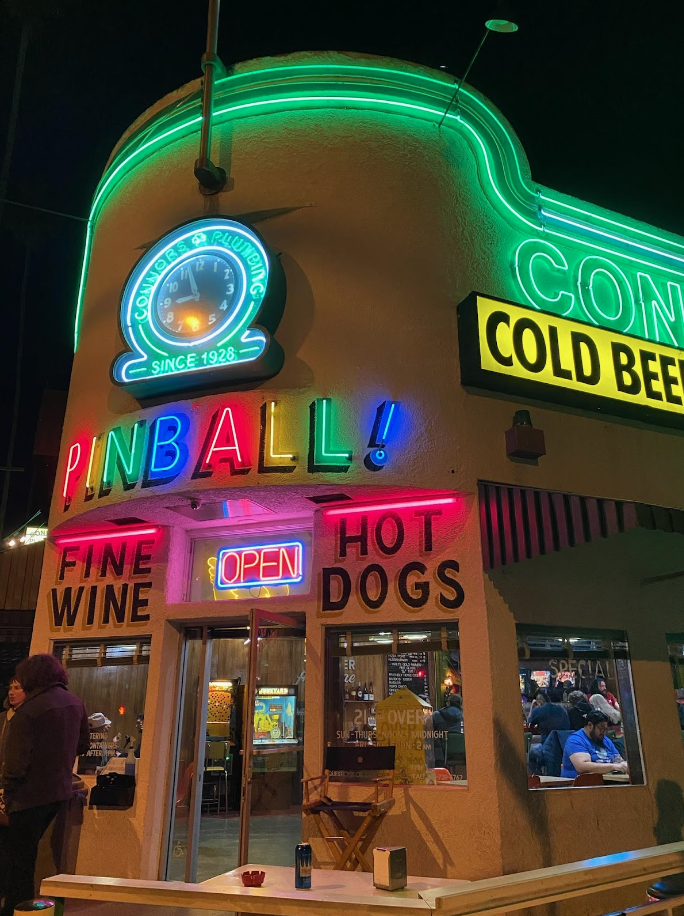
The first place that comes to mind when I think of playing in bars is a local hometown favorite, Walt’s. In a converted plumbing storefront,♣ Walt’s is the preferred joint for the young community of college students who attend the nearby Occidental College, as well as the local Eagle Rock community. Their services include pinball, cheap beer♥, wine, an outdoor patio, hot dogs♦ and a regular patron: a miniature Yorkie.♠ It’s hard to imagine that in a big city like Los Angeles, a bar like Walt’s can survive without serving liquor, but I think it is this exact feature that gives it such a playful charm. When you go to Walt’s you leave your pretension at the door—and your desire for an overpriced cocktail. Before I knew about the $4.50 can of Hamm’s, I would order a $7 beer on draught – not bad, but not great either. I learned about the Hamm’s after coming to Walt’s with a group of regulars. Having already ordered my draught pilsner, I was embarrassed that I didn’t join them in their joy for the dirt cheap can of bad beer. I will never order anything other than Hamm’s and a hotdog now.♣ It became very clear very quickly that you don’t go to Walt’s if you’re looking to refine your palate. You go to have fun, play pinball, drink cheap beer and eat hot dogs, the way your kid mind would have hoped adulthood would look like.
♣ The neon green sign for Connor’s Plumbing still decorates the front of the bar
♥ $4.50 for a can of Hamm’s!
♦ There’s also a vegan option if you’re one of those…
♠ Often spotted on top of a pinball machine, wearing an LA Kings jersey
♣ Never vegan, that’s for chumps
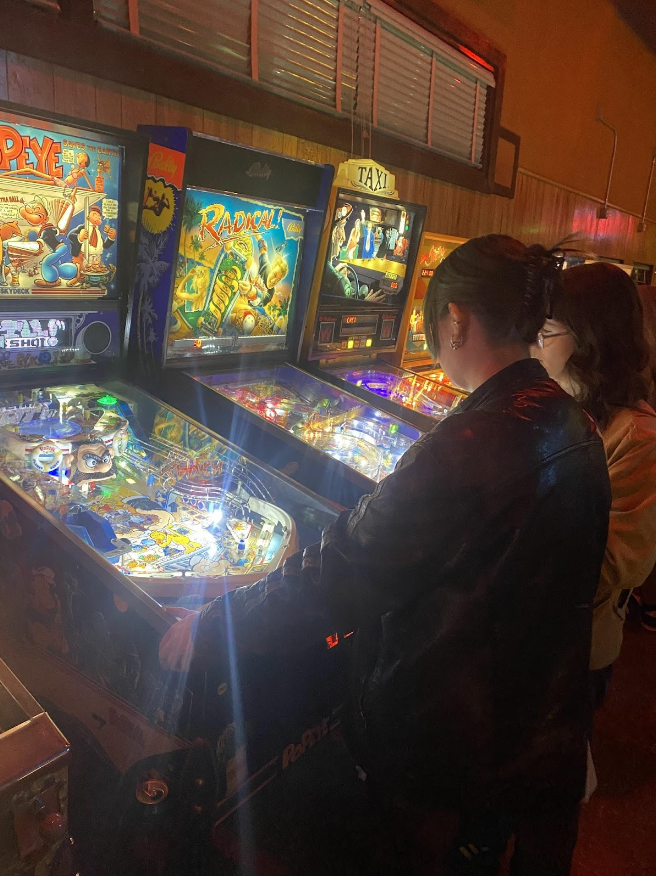
Pinball has a somewhat contentious history in the world of play. In the twentieth century, the game was made illegal due to its implications of gambling, loitering, and gangsters.♥ A surprising jump from the seemingly innocent fun that a pinball machine provides, this amusing history adds intrigue to the presence of pinball in bars. If you find yourself at Walt’s on a Wednesday night, you’ll need God on your side to get your grubby ketchup-covered hands on a pinball machine. Wednesday nights are tournament nights, meaning the pinball machines are reserved for those who take the game seriously. In his slightly sexist♦ thesis about the social implications of pinball, Stephen Conn writes that “participation in the community of pinball players is short-term; their participation in the larger society is a continuing event”.♠ Thus, the act of serious pinball playing creates a temporary community and solace for the player. When Walt’s holds their weekly pinball tournament, there is a mood shift. No longer do these machines provide a fun drinking activity for a group of friends. Coming from all different walks of life, participants come together for one purpose: serious play. If you don’t take the game seriously, you can enjoy your beer on the back patio or else come back when a winner has been crowned. Six days of the week, Walt’s functions as a bar where you can play pinball. But on Wednesdays, Walt’s is a pinball tournament with a bar, so you better know which day your presence is welcome.
♥ Can you believe it? My pinball-obsessed dad was the first person to tell me about that
♦ Basically he didn’t think women could understand pinball. For context, it was written in the ‘80s…
♠ Conn 13
In his assessment of games, Oldenburg decides that “a room full of individuals intent upon video games is not a third place.”♣ Claiming that these games do not stimulate conversation or placemaking, he argues that individualized play does not allow for the community feeling of a third place. Like video games, pinball is an individual play. When taken seriously, however, pinball welcomes community interaction as much as any other multi-player game. In fact, Stephen Conn notes that “[pinball] players learn how to dominate a machine by watching other players”.♥ In this sense, community is formed through the watching of other players. Though communication may be limited to the game, there is a cultural exchange of technique that does in fact create a public community. It is the draw of the game and the itch to get better that keeps players coming as regulars. Some people keep coming to Walt’s for the cheap beer, some for the hot dogs, some for the large patio, and many keep coming to get the high score on Captain Fantastic.♦
♣ Oldenburg 31
♥ Conn 14
♦ The Elton John themed pinball machine of course!
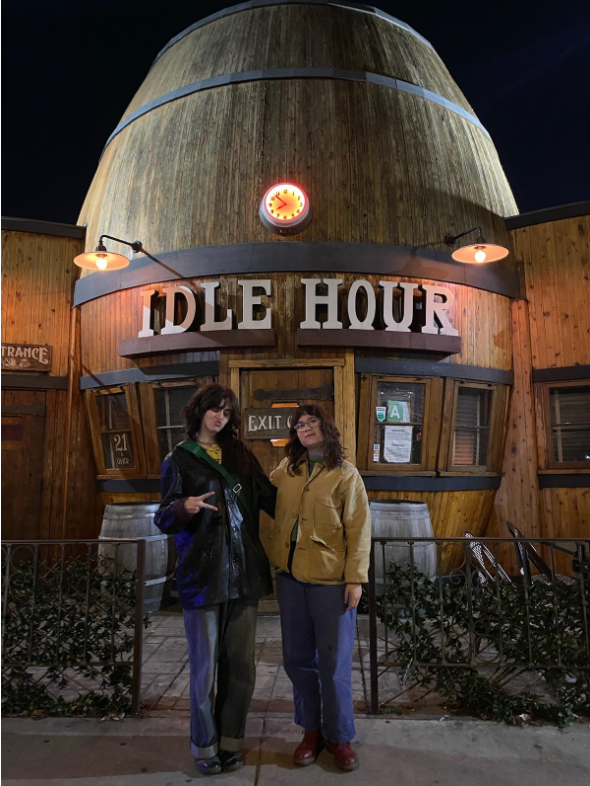
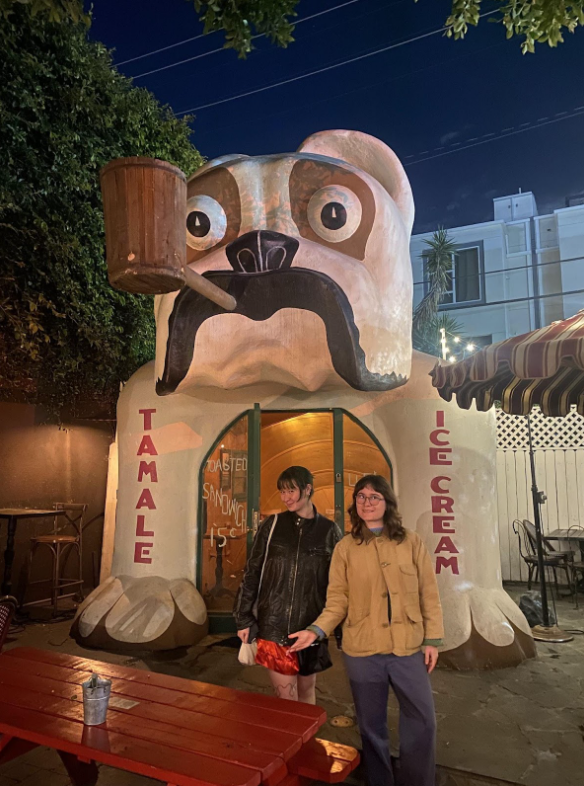
Ten minutes away from my childhood home lies one of the last relics of Los Angeles’ kitschy past. Idle Hour looks like a fish out of water in North Hollywood, standing proudly as a whisky barrel-shaped structure in the middle of a busy street that garners little foot traffic. There is something shocking about Idle Hour’s architecture, it feels almost too on the nose. But that’s why I love it. It shouldn’t be surprising that when you walk inside the barrel-shaped bar, you feel like you’re actually in the barrel, but everytime I step foot, I feel the charm of the place. If that wasn’t enough, when you walk outside to the patio, there is a giant structure of a dog smoking a pipe, and you can sit in it! Having grown up in Los Angeles, an ever-changing city, I was alway enchanted by its kitschy past. The playfulness of a giant donut indicating a donut shop, or a camera shop in the shape of – you’ll never guess – a camera, the mid-century architecture brings an element of play to this city. However, as time goes on, the buildings get uglier♠, the rising housing prices makes the once affordable San Fernando Valley harder to access, and the kitsch is lost. As LA changes, it tries to get more serious. It is now associated with the influencer, the struggling actor/director/producer/artist/magician, the $17 avocado toast, and the unbelievably high housing market. In a city where people go to bars to network, make content, or buy a $20 cocktail, the unseriousness of Idle Hour feels like a kitschy home away from home.
♠ No, not in a fun way
While I have been focusing on bars in my hometown of Los Angeles, play♣ exists all over the world, which is something I found out recently on a trip to Berlin. Traveling with one of my best friends who had studied abroad there the previous year, I requested that she just take me to her favorite spots for the entirety of our week-long trip. Having no say in where we would end up, I found myself at a gay bar called Monster Ronson’s Ichiban Karaoke.♥ On the particular night that we went, there was a drag show called “Poppers.” Hosted by a mostly naked drag queen named Bleach, the show consisted of a gorgeous drag king, several other mostly naked queens, a tray of poppers being passed around to the crowd, and a karaoke after party. If there’s anything that should be known about me, it’s that I love karaoke. I believe that what I lack in talent, I make up for in spirit.♦ When a young karaoke-loving queer walks into Monster Ronson’s Ichiban Karaoke on Poppers night, they’ve found the place. The place can only be described as my personal utopia. A place where an international crowd of queers can watch a German drag king in assless chaps lip sync to “Save a Horse, Ride a Cowboy” and then get up and perform their own drag superstardom through the medium of karaoke. It’s also a place where a straight European couple, who don’t know what poppers are♠, can sing “Don’t Go Breaking My Heart” without knowing any of the lyrics. Monster Ronson’s Ichiban Karaoke is a playful queer utopia for homos and heteros alike, and I never want to leave.
♣ And bars!
♥ How could I not talk about a bar with a name like that?!
♦ And I really lack talent
♠ I had to explain to them what poppers are and how to take them
Had queer theorist Jose Esteban Munoz found himself at Monster Ronson’s Ichiban Karaoke on Poppers night, I believe he also never would have wanted to leave. An expert on queer utopian place-making through performance, Monster Ronson’s may very well have been his mecca. At the very least, it was mine. Munoz argues that queer futurity can be imagined through performance. He sees queer performance as “a manifestation of a ‘doing’ that is in the horizon, a mode of possibility.”♣ When I do karaoke, I do not believe that there is an actual possibility for me to become a pop star.♥ Yet, the performance opens a door of possibility, it temporarily builds an imagined world where I am an icon. One where an audience of people are singing along to Nothing Compares 2 U, the song I wrote and made famous. It does not matter that I don’t have the pipes for it. In fact, Munoz argues that “the performances of amateurism […] signal a refusal of mastery and an insistence on process and becoming.” ♦ It is the fleeting minutes where I am on the stage, and I am the star of the show that allows me to forget my true identity and replace it with something I dream to be. Play is intrinsic in this performance. Were it not for my ability to play as a rock star, my willingness to forget the world outside Monster Ronson’s and create a new one inside this temporal space, the magic of karaoke and queer performance would not be present.
♣ Muñoz 99
♥ And if you heard my voice, you would certainly agree
♦ Muñoz 106
Growing up does not have to mean growing out of imaginative selves. In fact, turning 21 allowed me to enter a world of playful possibility. With play present, going out can become a radical activity, and one I always look forward to. So, dear reader, I invite you to momentarily leave your inhibition at the door of the next cheap bar you go to and by god have fun!♠
♠ Thank you for playing along!
Works Cited
Conn, Stephen. (1981). “The Social Context of Pinball: The Making of a Setting and Its Etiquette.” Paper presented at the Seventh Annual Meeting of the Association for the Anthropological Study of Play, Fort Worth, TX, Apr 1981.
Anchor, Robert. “History and Play: Johan Huizinga and His Critics.” History and Theory, vol.
Huizinga, Johan. Homo Ludens. Angelico Press, 2016.
Oldenburg, Ray. The Great Good Place : Cafés, Coffee Shops, Bookstores, Bars, Hair Salons, and Other Hangouts At the Heart of a Community. Cambridge, MA: Da Capo Press, 1999.
Munoz, Jose Esteban. “Stages: Queers, punks, and the utopian performative.” The SAGE Handbook of Performance Studies, 2006, pp. 9–20, https://doi.org/10.4135/9781412976145.n1.
