TO WATCH DOCUMENTARY, CLICK HERE
Artist Statement
On a cold, rainy day in March of 2024, members of Tank dining co-op– one of Oberlin College’s student dining cooperatives– erupted in a passionate discussion surrounding the ethicality of purchasing different fruits for the co-op. I have been a part of the Oberlin Student Cooperative Association (or, OSCA) for around 3 years now, and with every semester, the nuances of these co-op wise discussions still manage to surprise me. While there are many things which define life in a student cooperative, communal discussions such as these have been a consistent factor in the experience for as long as I can remember. Aside from cooking and cleaning with the same group of peers each day, the act of eating together, whether inside a small, lamplit lounge, or cross legged on the grass, is integral to both the communal feeling and logistic functioning of a dining co-op. Particularly, this routine of communal dining gives space and time for mealtime discussions to occur. These discussions often entail hiring student run positions such as Food Safety Coordinator, Dining Loose Ends Coordinator, Kitchen Coordinator, and other positions that assure the smooth running of the co-op. Occasionally, these discussions also include voting on what food is bought for the co-op, a discourse which involves the evaluation of ethical concerns and historic practices relating to food buying. With this short documentary, I intend to capture an observational account of such a discussion at Tank co-op– the camera’s frantic movement and “fly on the wall” approach mirroring the feeling of entering such a discussion without a clue of OSCA’s history or discussion practice.
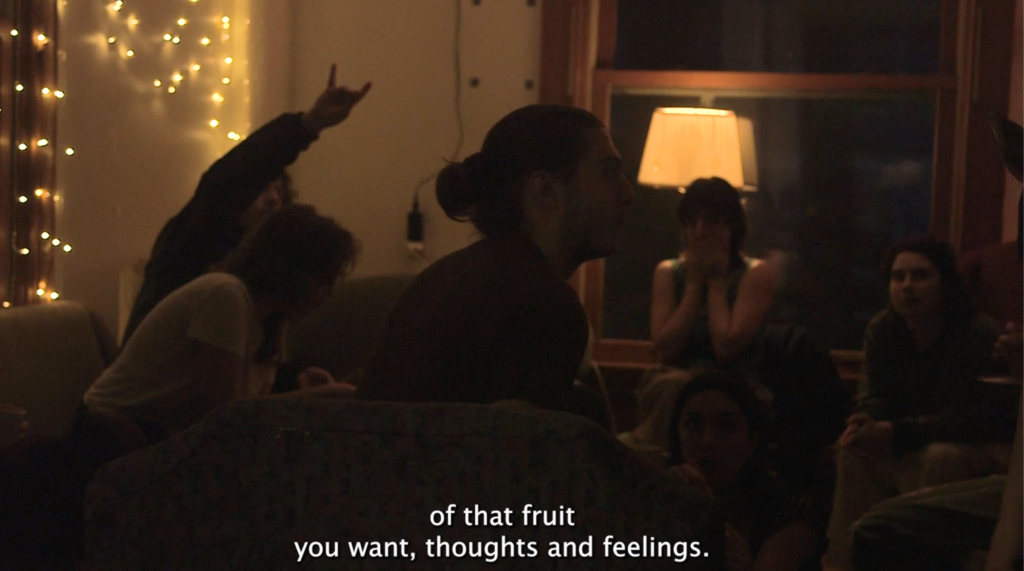
As Colin Ray Anderson, Lynda Brushett, Thomas W. Gray, and Henk Renting write in “Working together to build cooperative food systems”, “cooperative alternative food networks provide an alternative to the dominant or conventional food system by (a) reconnecting farmers and consumers in more direct and meaningful ways (. . .) and (d) promoting food production, distribution, and consumption processes that are environmentally sound and produce healthier food” (Anderson 3). This definition of food cooperatives outlines many of the goals of organizations such as OSCA, but does not address the ways in which these decisions get made and discussed by members of the cooperative– the main question I wish to answer within this short documentary. In the case of OSCA, with these goals of sustainability and food justice come elaborate hand signals gesturing to “proposals” made by members of the co-op, “opening stack” on discussion, and voting on certain proposals with a system of thumb gestures. Much of being a new member of OSCA is the practice of watching and listening in confusion at those around you who are already familiar with the co-op discussion procedure. Despite having now acclimated to the language of OSCA hand signs and abbreviations, I have since often assumed a position in co-op discussions which situates myself as more of an observer than an active participant. I believe that selfishly, some of this comes from a desire for these discussions to end faster. To the untrained eye, these discussions might last for ages, whether surrounding elections or just basic co-op procedure. The hand signals and impassioned dialogue can sometimes be entertaining to watch, sometimes productive and challenging, other times a dreadful accompaniment to a plate of pinto beans and cabbage.
My desire to make this short documentary stems out of the desire to portray the absurd, enthralling, often tedious procedure of OSCA discussions. The democratic ideal which seems to flourish in Oberlin’s various co-ops is often glamorized by people in and around OSCA– something I wish to not question, but simply modify. An outsider’s perspective into OSCA can be altogether awestruck, confused, annoyed, and neutral. I wish to capture the experience of observing a discussion that will very likely alter the way that your meals are served, kitchen is cleaned, or other things which are integral to the way that such a unique cooperative dining establishment functions. My aesthetic and structural vision for this piece is wholly inspired by the work of Fredrick Wiseman and D.A. Pennebaker, two documentary filmmakers who have pioneered many of the techniques of observational documentary filmmaking we see today. Just as Wiseman’s camera follows unbroken sequences of logistical discussion in the New York Public Library or the Boston City Hall, (read a review of Wiseman’s newest documentary HERE) I wish to capture the real time back and forth between co-op members, as both a way to preserve OSCA history and also to allow others to witness the ways in which such a organization functions.
Imogen Pranger is a 4th year Cinema & Media major at Oberlin College.
BIBLIOGRAPHY
Anderson, C. R., Brushett, L., Gray, T. W., & Renting, H. (2014). “Working together to build cooperative food systems”. Journal of Agriculture, Food Systems, and Community Development, 4(3), 3–9.
Town Bloody Hall, directed by D.A. Pennebaker and Chris Hegedus (1979, New York, 20th Century Studios)
Ex Libris, directed by Fredrick Wiseman (2017, USA, Zipporah Films)
