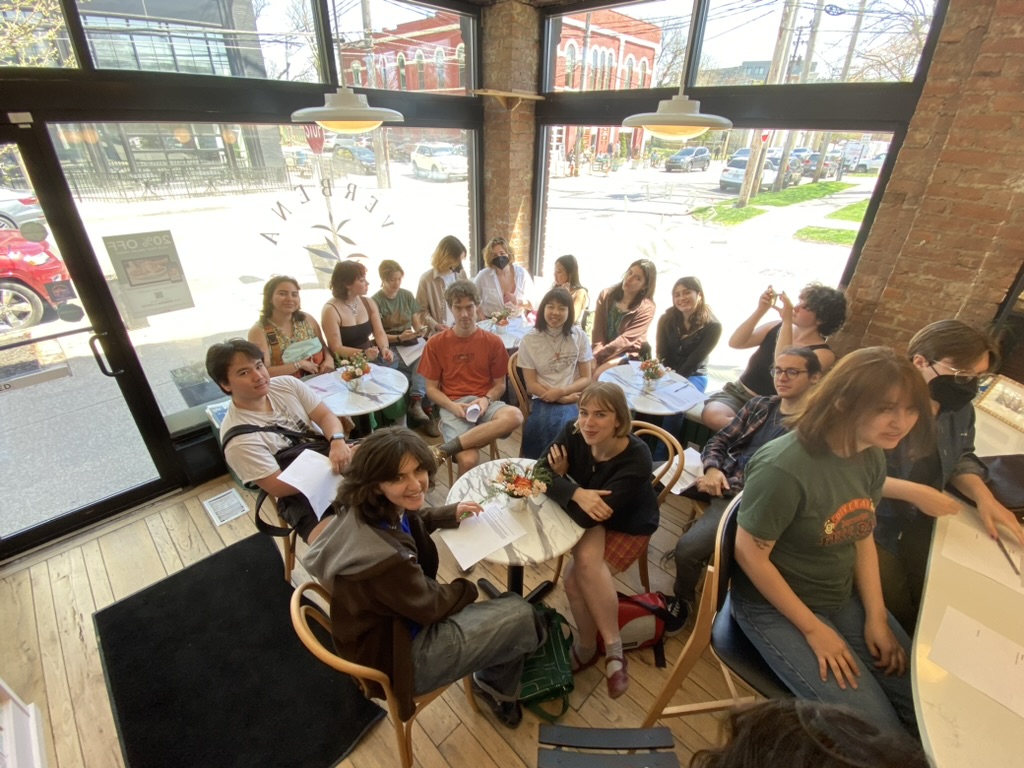
During the year 2023 I spent a semester studying abroad. I studied abroad in the Scandinavian country of Sweden, known for its tall blond citizens, its welfare model, and for some, its love of coffee. When I arrived in Sweden with my program (the uselessly named “Swedish Program”) they gave me a crash course in Swedish culture. One of the big features they stressed was the concept or institution of “fika.” What is fika? Fika is a social break time that you can take when you need a break from something, from work, chores, hiking, whatever it is you can fika when you need a break. Once you decide to fika you go to a cafe with a friend and grab coffee (tea is ok too) & something to eat. What was surprising to me, and my fellow American students, is that many companies in Sweden have mandatory times for fika, when it’s time for fika you have to stop working. What is crucial for a break to be considered “fika” is the presence of another person. You cannot Fika by yourself, that is called being alone in a cafe. Fika spread like wildfire among the program students. If you went to the cafes near the school in between or after classes you would see several loud Americans drinking coffee and eating pastries together.
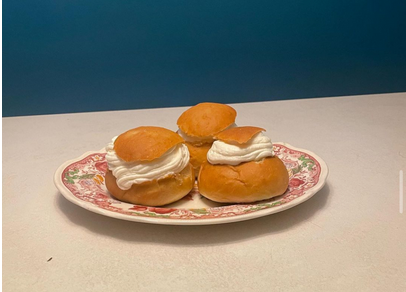
What we didn’t know as we drank our hot beverage and ate a cardamom infused pastry, was that we were digging into 300+ years of Swedish historical development and its colonial legacy. Sweden did not always have fika, and the elements that make up a modern “proper” fika have changed or been introduced over time. Cardamom is a great example because its native origin in India is so far from Sweden. In this journey through Sweden’s history via fika the first thing I want to discuss is the pastry, and one pastry in particular, the semla. Visitsweden.com defines a semla as: “A Swedish ‘semla’ is a delicious sweet bun with an almond paste and whipped cream filling. Traditionally eaten for Lent (the Christian fasting period), ‘semlor’ (the plural form of semla) are now consumed from New Year’s until Easter.”1 Something interesting about this statement is the idea that semlor were eaten the day before Lent. This day is actually a holiday in Sweden called “Semmeldagen” also known as Shrove Tuesday. But what is important is that semlor are now eaten months before Semmeldagen, no longer just before Lent, though people eat more on that day then the rest of the year. I certainly did not eat a semla during the traditional time when I was in Sweden, I ate them from local cafes whenever I felt like it! My ability to get semlas during Lent is an example of something that happened in Sweden and many other developed countries, secularization. As of 2021 around 38% of the Swedish population described their beliefs as “no religion”, compared to the United States where a 2019 Pew Research poll found that 26% of Americans said they had no religious identification.2 Secularization has hit Sweden hard, to the point where almost 1 in 4 Swedes aren’t religious and religious traditions, like when to eat semla, are no longer being followed.
Credit: Conner Levitt
When I first had a semla, a particular flavor stood out to me, the flavor of cardamom. As I was soon to learn, Swedes loved putting cardamom on pastries. A cardamom bun is one of the classic things to eat with your coffee during fika. Swedes love putting it in everything including waffles, cookies, and even beer!3 Upon learning of the Swedish obsession with cardamom, a question came to my mind. How did Sweden become so fond of an expensive spice that originates in India? One theory says that cardamom was first introduced via viking traders in Constantinople, but that idea is not widely accepted. The earliest evidence of cardamom in Sweden comes from a 13th century cookbook that lists cardamom as being medicinal as well as being good against the cold.4 According to the curator of the Nordic Museum in Sweden, Ulrika Torell, we know for sure that cardamom appears in some recipes for “seasoning wine, spirits and confectionery” from the 16th century, but that does not explain its widespread use today.5 Cardamom at that time would only be for nobles due to prohibitive prices. To see the beginning of Sweden’s cardamom cravings one has to look to the 18th century and the Swedish East India Company.
Sweden, like other European countries during the 18th century, had an East India Company, though it never got close to the power of the British East India company. The Swedish East India Company (SEIC) was different from other East India companies in that it had no territorial bases or ports, it was a purely commercial endeavor.6 With the SEIC cutting out most of the middlemen, cardamom became a lot cheaper in Sweden, though it was still more of a spice for the wealthier people of Sweden.7 Even still, it is believed that the broad Swedish taste for cardamom began fully during this time.

Credit: Wikipedia
Despite this rise in cardamom consumption during the 18th century, the modern semla did not exist yet. The visitsweden.com recipe calls for all sorts of baking materials, spices, and other ingredients that were not so easy for the average Swede in the 19th century to get ahold of. One reason for this is that Sweden for a long time was a relatively poor country: it began its industrialization in the 1860’s but this process took many years. The “modern” semla only began after the world wars. Sweden remained (officially) neutral during both world wars and reaped the benefits of this neutrality. While most of Europe had its population decimated and cities destroyed by the world wars, Sweden was untouched, and even managed to profit during the wars through trade with Germany. This growth combined with successful industrialization culminated in the creation of the modern semla in the 1950’s.8 Sweden was able to import all of the necessary baking and spice goods from post-WW2 free trade, and average Swedes were able to afford all the imported ingredients. Thus, the semla we eat today is a product of 1950’s wealth, quite different from the semla of old.
Now that we have gone through Swedish history through the semla, it is time to look at the true essence of Fika: coffee. Coffee became popular in Sweden during the 18th & 19th centuries. During this time coffee was sweeping Europe as the drink of choice for aristocrats and merchants alike. Along with other countries like the UK or France, Sweden began to develop coffeehouse culture, particularly in the capital city Stockholm. Once again following the trends of other countries, the Swedish monarchy became worried about coffee and coffeehouse culture. In 1746 the Swedish monarchy placed a heavy tax on coffee and eventually banned it in 1756.9 Despite these restrictions Swedes still met up in secret to drink coffee and a coffee black market emerged.10 Another king, Gustav III was (understandably) paranoid about coffee and coffeehouse-based rebellion after his coup in 1772, but unlike his predecessors he was also paranoid about the health effects of coffee. To test how dangerous coffee was he took a pair of condemned prisoners who were twins and made one drink 3 pots of coffee every day while the other drank 3 pots of tea. He wanted to see which twin would die first, but they both outlived Gustav as he was assassinated in 1792 by a group of noblemen. The twins even ended up outliving the doctors!11 Finally, in the 1820s the Swedish monarchy bowed to coffee and lifted the ban on it. From then on coffee would become a mainstay in Swedish life as the price decreased and more & more people began using the drink.
In the century following the lifting of the ban on coffee we see the first use of the word Fika. That magical word emerged in the 19th century as a slang for the word coffee, kaffe in Swedish. It works like this, take kaffe, split it in half and put it back together reversed. Kaffe becomes ka-ffe which becomes ffe-ka, fika! Scholars are unsure of how the fika slang term became the name for the social meal but I believe that it had to do with the royal repression of coffee and coffee drinking. During the bans & taxes on coffee, people would mostly drink coffee together in secret. If you had a regular schedule and people to drink with wouldn’t you continue those plans once coffee became legal? I think that the rituals and drinking groups that were created during the repressive period continued after the restrictions were lifted and that this gave fika its distinct social character. Another way this social character charts Sweden’s path is how Fika has been incorporated into Swedish work culture. The aforementioned required fika breaks during work are part of Sweden’s image as a capitalist country but a more relaxed, less aggressive one than countries like the USA. Another example of this is the expansive Swedish welfare & healthcare system (though it is only for citizens but that is a topic for another time).
Fika and semlor are two food based institutions where we can look at how they emerged and changed to see how the country of Sweden grew and changed along with them. From humble beginnings as a traditional Christian Fat Tuesday delight, semlor took on new meaning and tradition as the country of Sweden modernized, secularized, and industrialized. The availability and physical ingredients of the Semla changed over time, incorporating ingredients like cardamom which were not widely available until 18th century capitalism & merchant ventures cut out the middleman and lowered the price. Even still, the modern semla still did not exist until the 1950s when Swedish wealth and increased free trade (at least outside of the Warsaw Pact) allowed the average Swede to be able to purchase or make one themselves. Fika had a similar evolution, though it is not as old as the semla. Coffee came to Sweden with the same capitalism and merchant ventures that brought cardamom, but unlike cardamom it was both more widely adopted & restricted by the state/monarchy. Like the rest of Europe, Sweden’s monarchy could not resist coffee forever and eventually had to end its restrictions. Fika then emerged as a slang term for coffee and gained a social character. I suspect that part of this character comes from comradery during the repressive period, and part of it comes from the less intensive, more communal nature of Swedish capitalism. A counterpart in other countries may be the evolution of the hamburger from immigrant food to Americana staple. Food based traditions are a record of how a place changed, and it is important to explore our own food to look at where it came from and where it might go. As Sweden becomes ever more secular it may start producing semlor at all times of the year, and if it becomes more right-wing and vitriolic, the communal aspect of fika may be lost or minorities may be excluded from it altogether.
Overall, semlor and fika are part of another trend that I see, people from other countries and cultures desiring parts of Swedish or Scandinavian culture. Smorgasbord, architectural styles, IKEA, etc. The rest of the “West” just loves Scandinavia. For example, Fika is a very enjoyable cultural experience, but is also one of those things that writers from other developed countries look at and think: “oh I wish my country was more like Sweden!” Why is that? I believe it is because people in other capitalist countries, especially the United States, look at the kinder nature of Swedish capitalism or society and want that for their own. Or they always see “Scandinavia ranks among the world’s happiest countries” and want to emulate that success. However, semla and fika did not suddenly appear, they changed and evolved along with Sweden itself ,so I hesitate for other countries to just fully adopt these practices, as much as I wish we had fika in the United States. Can you imagine American corporate bosses making mandatory hour long coffee breaks twice a day?!?!? For other countries to gain institutions like fika the culture needs to be more communal and laid back like Sweden’s is.
For the semla though, bakers here can start making them whenever they want and I’ll be first in line.
Conner Levitt OC ’24 is a lover of ice cream and other sweet treats. Majoring in sociology, they like trying to see history play out in the experiences of everyday life.
- https://visitsweden.com/what-to-do/food-drink/recipes/fat-tuesday-buns-semla-recipe/ ↩︎
- https://www.pewresearch.org/religion/2019/10/17/in-u-s-decline-of-christianity-continues-at-rapid-pace/ ↩︎
- https://www.bbc.com/travel/article/20231213-swedens-enduring-love-for-cardamon-and-buns ↩︎
- bbc.com Article ↩︎
- bbc.com Article ↩︎
- https://www.jstor.org/stable/44156313 ↩︎
- bbc.com Article ↩︎
- bbc.com Article ↩︎
- https://vinepair.com/articles/the-bizarre-history-behind-fika/ ↩︎
- Vinepair.com Article ↩︎
- Vinepair.com Article ↩︎
