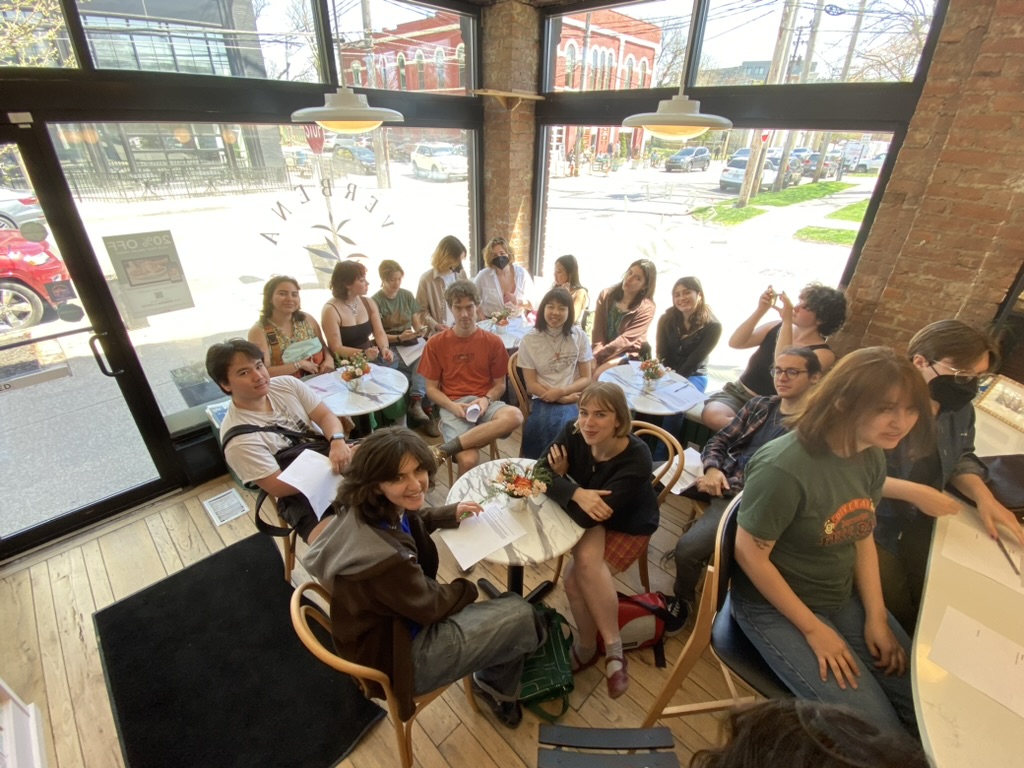
“You get up when the world is warm, or at least, when it is not so cold. You are, therefore, able to prolong your Saturday nights.”
Guy Beringer, 1895, Inventor of Brunch
Brunch is an illusion of the good life. It is fun; it is social; it is glamorous in one way or another. In all its combination of various elements, brunch is leisure. American sociologist Thorstein Veblen defines leisure as consumption “beyond the minimum required for subsistence” which also “undergoes specialization as regards the quality of the goods consumed.”1 This certainly applies to brunch, which often aims to provide innovative flavor combinations within familiar breakfast food structures. Brunch can definitely get fancy, with long lines, pomp, and exposed-brick aesthetics that hypocritically reference an “industrial working life, without the work itself, [while] the actual work that goes into making brunches happen is conspicuously left out of the celebrated brunch narrative.”2
But while brunch is notoriously expensive and busy, this is not to say that it is only participated in by the leisure class. Rachael Popowich, a cook at Toronto’s quintessential brunch spot Aunties & Uncles, reflects on how brunch is sought out as conspicuous consumption––an act of embodying status through the consumption of wealth-associated goods3–– regardless of disposable income: “A lot of people who don’t have a lot of disposable income will choose to use what they do have on brunch, just to feel like, ‘On my day off, I can dabble in this lifestyle.’”4
A lot of people who don’t have a lot of disposable income will choose to use what they do have on brunch, just to feel like, ‘On my day off, I can dabble in this lifestyle.’
Rachael Popowich
The concept of brunch was first documented in an 1895 opinion piece by Guy Beringer, entitled “Brunch: A Plea.” Beringer proposes a “corruption of breakfast and lunch,”5 at half past noon, as an alternative to Sunday Mass. This way, people could stay out later on Saturday nights, and still commune in the morning, just later in the day, and without the religious part. His vision of brunch is sociable and cheerful, with three courses of fish and meat, and beer or whiskey in place of tea or coffee.
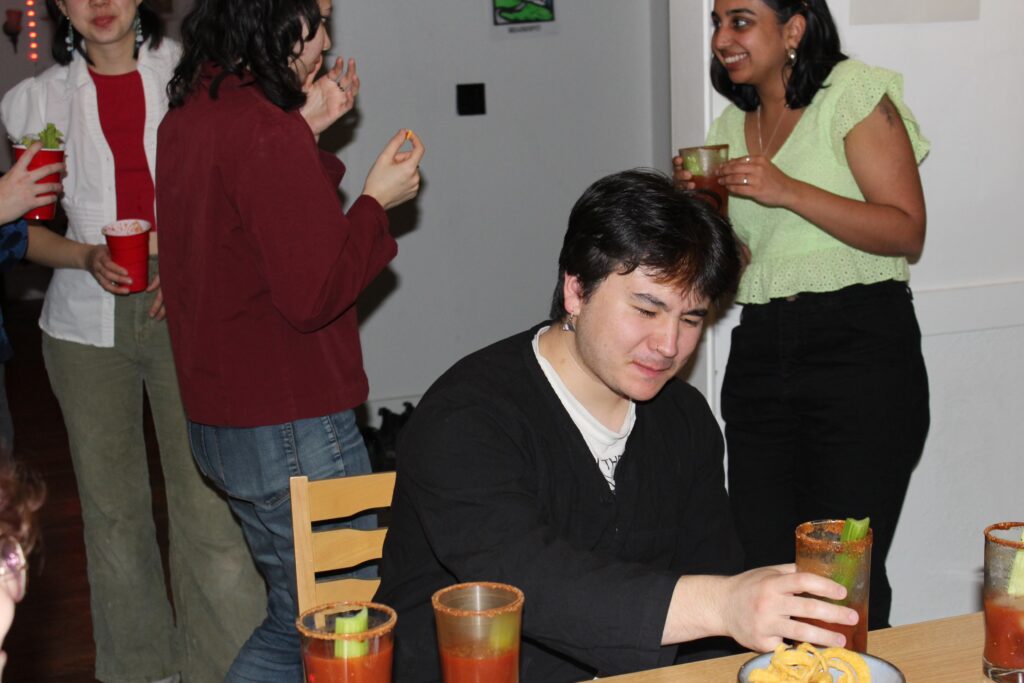
Indeed, the history of brunch is intertwined with that of cocktails. The Prohibition Act of 1919 prohibited the sale of alcohol, and was enforced from 1920 to 1933; as brunch was entering the mainstream, so too was alcohol re-legalized with the Prohibition Act’s repeal. Farha Bano Ternikar, author of Brunch: A History, writes:
“Many of the earliest brunch cocktails were some combination of vodka or champagne and fruit juices. Citrus juices had already been popularized as a breakfast tradition, so juice-based cocktails were a natural outcome of the combination of Prohibition and brunching, especially with the popular idea that ‘the hair of the dog that bit you’ was the best cure for a hangover.”6
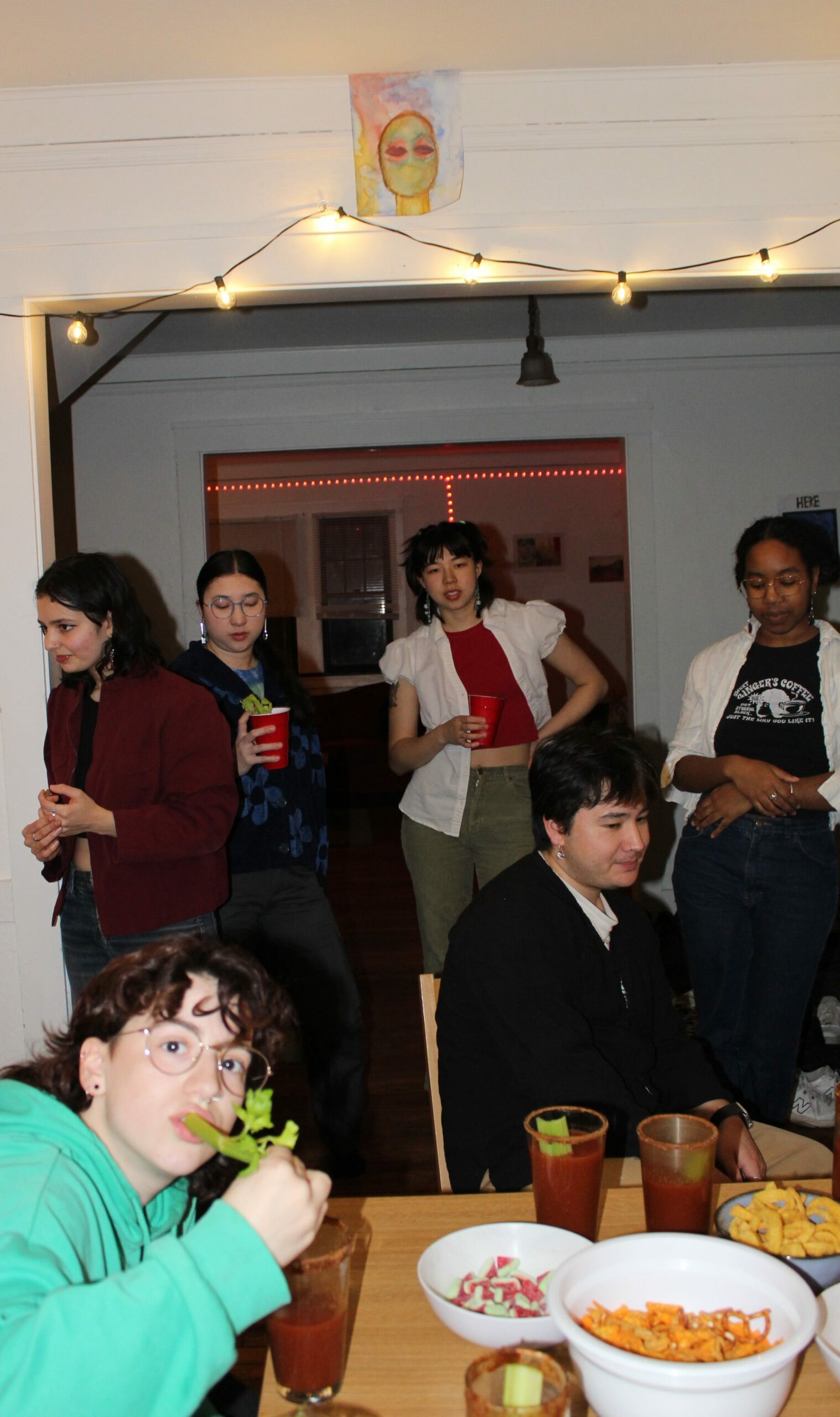
A century later, we seem to agree: “Brunch is a breakfast that begins with a cocktail,”7 William Grimes writes in his 1998 New York Times opinion piece, “At Brunch, The More Bizarre The Better.” To Veblen, this in and of itself is a mark of leisure. He writes: “Drunkenness and other pathological consequences of the free use of stimulants therefore tend in their turn to become honorific…of the superior status of those who are able to afford the indulgence.”8 In other words, drinking in the morning, socially looked down upon as a vice or symbol of incompetence, can alternatively be a symbol of status in the right context. If you don’t have somewhere to be, something to do, or someone to take care of, comfortably spending ten dollars or more on a cocktail at brunch is a performance of leisure that you get to both experience and display to others. Popowich agrees: “It’s like adults getting to be mischievous children. Ooh, we’ll drink at breakfast. Let’s be naughty. We’re going to spend all this money on eggs and feel fabulous.”9
Drinking in the morning, socially looked down upon as a vice or symbol of incompetence, can alternatively be a symbol of status in the right context.
Epitomizing the mischief of cocktails at brunch is the Bloody Mary. A corruption in and of itself, the Bloody Mary combines tomato juice, vodka, horseradish, hot sauce, and lemon. While it’s an extremely popular brunch staple, it is also, understandably, very divisive.
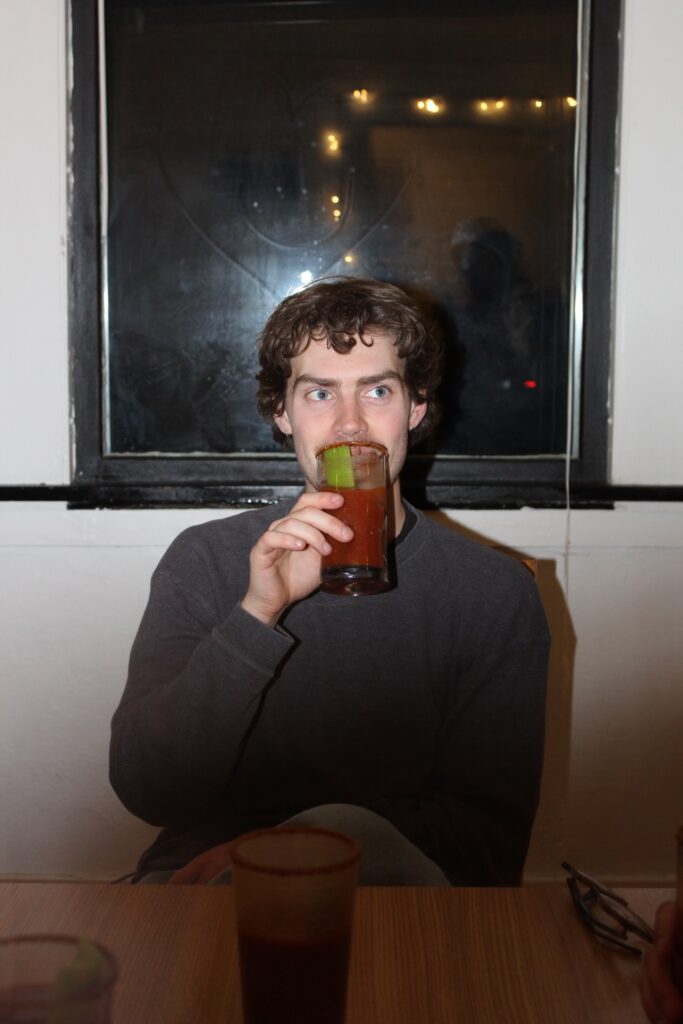
And truthfully, until I tried it, the Bloody Mary baffled me, scared me, even. Becky Lang of The Tangential says it well: “Do you think Bloody Marys are disgusting because they are salty, bitter and strange? You’re not alone.”10 My first Bloody Mary was split three ways at Saturday brunch on my twenty-first birthday at the Feve. This was when I discovered my love for the salty, bitter, and extravagant. It was savory; it was spicy. It was topped with pickles and peppers, with a whole skewer dedicated to olives. My eyes were opened. I understood that my life had always been leading up to this point.
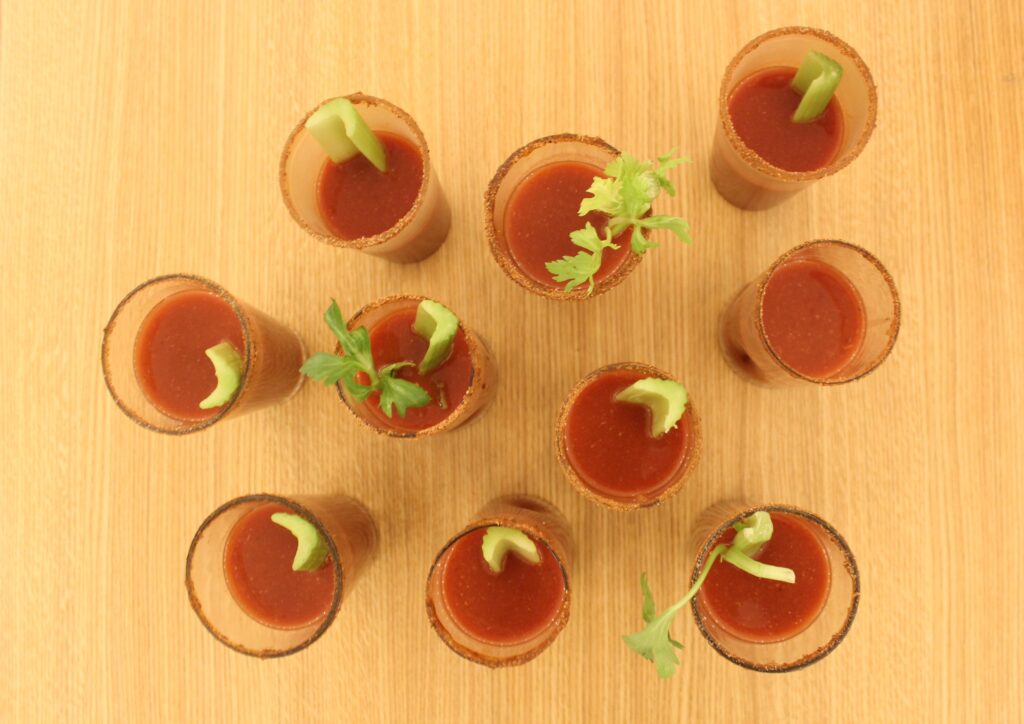
The Bloody Mary of today is defined by seven key features:11
1) tomato juice;
2) the base spirit, often vodka;
3) savory additives such as Worcestershire sauce, or beef consommé;
4) spices and herbs;
5) the burn: horseradish and hot sauce;
6) acid, often lemon juice; and
7) aromatic garnishes, such as celery, or more excitingly, skewers of meat, cheese, and pickled vegetables.
The Bloody Mary’s strangeness makes you wonder who could have invented such a mouth-wateringly savory treat. It would be easy if there was one person who published “Bloody Mary: A Plea” like Guy Berringer did with brunch. Unfortunately, the origin of the Bloody Mary is heavily debated, and understandably so, because who wouldn’t want to have invented it? Still, a few main characters stand out: Fernand Petiot, George Jessel, Henry Zbikiewic, and Mary Brown Warbuten.
In his prime, Fernand Petiot wore rimless glasses and dressed like a professor. He was born in Paris, France in 1900 to parents who owned a boarding house. At the age of 16, Petiot began working at the infamous Harry’s New York Bar (in Paris) as a kitchen boy, moving his way up to bartender and gaining the nickname “the Frog.”12 Here, he is said to have made a tomato juice and vodka cocktail. Some doubt this because no tomato juice cocktail was included in Harry McElhone’s (of Harry’s New York Bar) 300-recipe book, Barflies and Cocktails, published in 1927,13 but I don’t think that can truly imply its nonexistence.
George Jessel was born in New York City in 1898 to a playwright and a ticket seller. By age 10, he began appearing on Broadway, later settling into a lifelong career of comedy with “ethnic” humor, divorce scandals, and campaigning for Ronald Reagan. Some remember him as the “toastmaster general of the United States.”14 In 1927, while Petiot was in Paris and Barflies and Cocktails failed to publicize his tomato vodka cocktail, George Jessel claimed he invented it after a night of drinking in Palm Beach, Florida. As a potential hangover cure, the hotel bartender had offered him something he called vodkee, a pungent potato-smelling vodka no one had drunk in six years. Inspired by his sister-in-law’s use of tomato juice as a hangover cure, Jessel recalls telling the bartender, “Get me some Worcestershire sauce, some tomato juice, and lemon; that ought to kill the smell.”15
He is quoted more gracefully in a Smirnoff ad:
“I think I invented the Bloody Mary, Red Snapper, Tomato Pickup, or Morning Glory. It happened on a night before a day and I felt I should take some good, nourishing tomato juice, but what I really wanted was some of your good Smirnoff Vodka. So I mixed them together, the juice for the body and the vodka for the spirit, and if I wasn’t the first ever, I was the happiest ever.”16
George Jessel’s Bloody Mary
1.5 OUNCES VODKA
3 OUNCES HEAVY TOMATO JUICE
WORCESTERSHIRE SAUCE
LEMON JUICE
Critics argue that canned tomato juice didn’t debut in the US until 1928, manufactured by the College Inn Tomato Factory. Where was he getting his tomato juice from? I’m not sure I buy this; tomatoes are juicy enough. But I do find it hard to trust that he, hungover, asked for all those ingredients.
Henry Zbikiewic, a bartender of unfortunately unknown origin at the Prohibition-era speakeasy 21 Club in Greenwich Village, was also known for making tomato juice and vodka cocktails around this time, but it’s unclear whether he invented them. Since George Jessel was a frequent customer of the 21 Club, it’s possible some collaboration was afoot.
Fernand Petiot left Paris for Ohio in 1925, eventually settling in New York in 1933, where he worked at King Cole Bar at the St. Regis Hotel. There, he introduced a drink to the menu that he called the Red Snapper: vodka, tomato juice, citrus, and spices. Legend has it, he originally wanted to call the drink the Bloody Mary, but the name was deemed too offensive by the hotel owner’s son. In a 1964 interview with The New Yorker, Petiot revealed his recipe:
“I initiated the Bloody Mary of today. George Jessel said he created it, but it was really nothing but vodka and tomato juice when I took it over. I cover the bottom of the shaker with four large dashes of salt, two dashes of black pepper, two dashes of cayenne pepper, and a layer of Worcestershire sauce; I then add a dash of lemon juice and some cracked ice, put in two ounces of vodka and two ounces of thick tomato juice, shake, strain, and pour. We make a hundred to a hundred and fifty Bloody Marys a day here in the King Cole Room and in the other restaurants and the banquet rooms.”17
Fernand Petiot’s Bloody Mary
4 DASHES SALT
2 DASHES BLACK PEPPER
2 DASHES CAYENNE PEPPER
1 LAYER WORCESTERSHIRE SAUCE
1 DASH LEMON JUICE
CRACKED ICE
2 OUNCES VODKA
2 OUNCES THICK TOMATO JUICE
The bloody bit of the name seems intuitive for a viscous red drink, even more so than the name Red Snapper, which is just a red fish. And it’s not unbelievable that a woman’s name is involved, considering the association of womanhood with blood. How does Mary fit into the puzzle?
i.
The title “Bloody Mary” is mainly associated with the sixteenth century English queen, Mary I. Her father was Henry VIII, who famously broke up the Catholic church, reinventing divorce in order to leave Mary’s mother. Mary was downgraded from Princess to Lady and separated from her mother. When Henry VIII died, nine-year-old Protestant Edward VI became king, only to die before reaching the age of sixteen. Though Mary was not officially heir to the throne, she fought her way into reigning, becoming the first English queen, corrupt in her own right. Mary spent her five years as queen restoring the Catholic Church, ordering 280 Protestants to be burned at the stake before she died in 1558.18 Many consider her notorious title of Bloody Mary to be rooted in misogyny; her father ordered the deaths of way more people, an estimated 57,000 to 72,000,19 and no one calls him Bloody Henry.
ii.
Bloody Mary is an American ritual associated with young girlhood. You turn off the lights; you go in front of a mirror; you say “Bloody Mary, Bloody Mary, Bloody Mary,” and Mary will appear, looking back at you. Maybe she has blood on her face. Maybe you have to flush the toilet three times. It’s often a slumber party activity; some scholars theorize a connection to pre-pubescent menstruation anxiety. This Mary, unrelated to English monarchy, is associated with theoretical witches Mary Whales and Mary Worth, or even the Virgin Mary.20
iii.
Soon after mixing his first makeshift hangover blend,
George Jessel recalls giving one to his friend
Mary Brown Warbuten. It tumbled down
her white evening gown before reaching the floor.
Smocked in tomato and vodka, she laughed:
Now you can call me Bloody Mary, George!
Appendix: Recipe used for Bloody Mary Party
Adapted from Joseph Conklin, Broder and Broder Nord, Portland, OR, “The Danish Mary” from The Bloody Mary by Brian Bartels
Makes 4 quarts, enough for 16 drinks
INGREDIENTS
3 teaspoons celery seeds
3 teaspoons fennel seeds
3 teaspoons dill seeds
3 teaspoons cumin seeds
3 teaspoons red pepper flakes
1 bunch dill, chopped
6 ounces porter or Guinness stout
6 ounces tomato paste
½ cup prepared horseradish
4 ounces freshly squeezed lemon juice
2 ounces balsamic vinegar (vegetarian) or Worcestershire sauce (not vegetarian)
3 teaspoons garlic powder
3 teaspoons celery salt
3 teaspoons freshly ground black pepper
1 ½ teaspoon ground cumin
1 ½ teaspoon mild curry powder
1 teaspoon cayenne pepper
100 ounces tomato juice
DIRECTIONS
In a nonstick sauté pan over medium heat, toast the celery seeds, fennel seeds, dill seeds, and cumin seeds just until fragrant, about 3 minutes. Let cool. Combine the toasted seeds, red pepper flakes, and dill in a cheesecloth sachet and set aside.
In a 2-quart sealable container, combine all of the remaining ingredients except the tomato juice. Add the sachet of spices and herbs, mix well, and pour in the tomato juice. Stir to blend. Seal the container and refrigerate for at least 1 day, to allow the flavors to integrate, and up to 1 week.
Remove the sachet after 1 day. Mix well before using.
To serve 1:
Celery salt rim
2 ounces vodka
6 ounces danish mary mix
Footnotes
1. Thorstein Veblen, The Theory of the Leisure Class (London: Macmillan, [1899] 1915), p. 73.
2. Shawn Micallef, The Trouble with Brunch: Work, Class and the Pursuit of Leisure (Toronto: Coach House Books, 2014), p. 75.
3. Veblen, p. 34.
4. Micallef, p. 80.
5. Guy Beringer, “Brunch: A Plea,” Hunter’s Weekly (1895): accessed February 27, 2024, https://en.wikisource.org/wiki/Brunch:_a_plea.
6. Farha Bano Ternikar, Brunch: A History. (Lanham, MD: Rowman & Littlefield, 2014).
7. William Grimes, “At Brunch, The More Bizarre The Better,” New York Times, July 8, 1998, https://www.nytimes.com/1998/07/08/dining/at-brunch-the-more-bizarre-the-better.html.
8. Veblen, p. 70.
9. Micallef, p. 81.
10. Becky Lang, “Understanding People Who Like Bloody Maries,” The Tangential, April 6, 2013, https://thetangential.com/2013/04/06/understanding-people-who-like-bloody-maries- a-guide-for-people-who-hate-them/.
11. Kevin Liu, “The Bloody Mary: The History and Science of an Oddball Classic,” Serious Eats, February 15, 2023, first published June 2014, https://www.seriouseats.com/bloody-mary- good-science-history-what-type-of-vodka-can-it-cure-a-hangover.
12. Geoffrey Hellman, “The Talk of the Town: Barman.” The New Yorker, July 18, 1964, pp. 19-20.
13. Brian Bartels, The Bloody Mary: The Lore and Legend of a Cocktail Classic. (Berkeley, CA: Ten Speed Press, 2017).
14. “George Jessel, Comedian and Toastmaster, Dies at 83,” New York Times, May 25, 1981.
15. George Jessel, The World I Lived In (Washington, D.C.: Regnery, 1975), pp. 84.
16. “Smirnoff Vodka 1956 George Jesse Bloody Mary,” Mad Men Art: Vintage Ad Art Collection 1891–1970, accessed March 30, 2024, https://www.madmenart.com/vintage-advertisement/ smirnoff-vodka-1956-george-jesse-bloody-mary/.
17. Hellman, p. 20.
18. Meilan Solly. “The Myth of ‘Bloody Mary,’” Smithsonian Magazine, March 12, 2020, https://www.smithsonianmag.com/history/myth-bloody-mary-180974221/.
19. Lauren Mackay, “How many executions was Henry VIII responsible for?” History Extra, December 28, 2014, https://www.historyextra.com/period/tudor/how-many-executions-was- henry-viii-responsible-for/.20. Alan Dundes, “Bloody Mary in the Mirror: A Ritual Reflection of Pre-Pubescent Anxiety,” Western Folklore 57, no. 2 (1998): 119–135, https://doi.org/10.2307/1500216.
Shira Friedman-Parks, OC ’24, majored in sociology. She likes to make drinks of all kinds.
