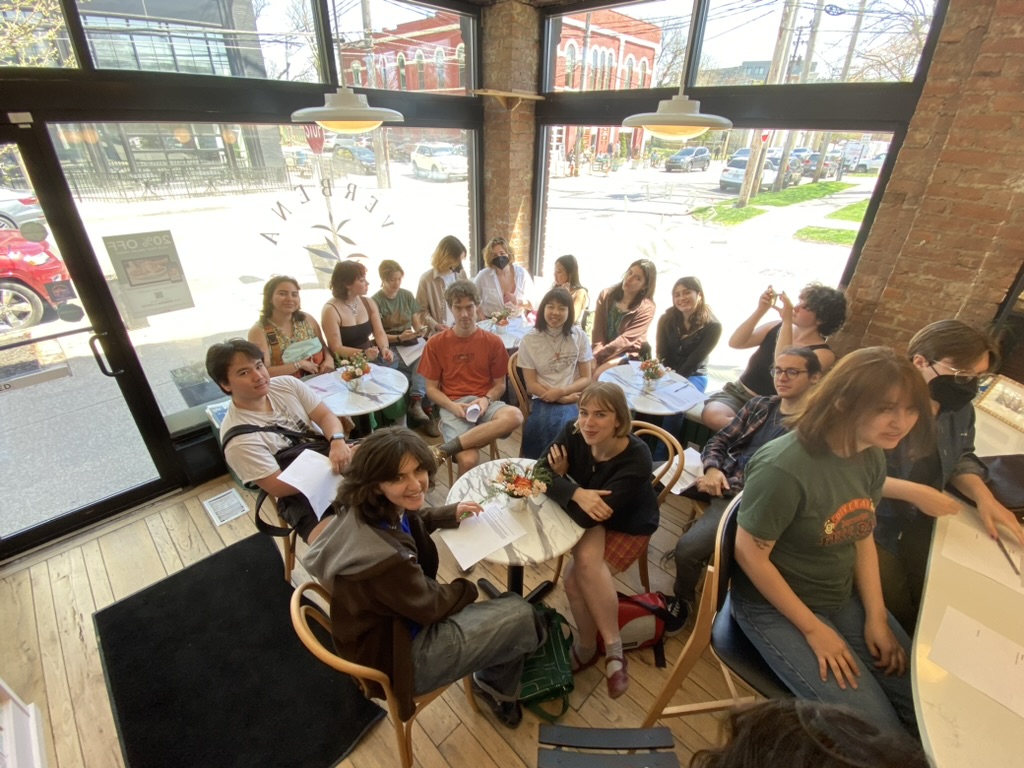
Accounts from an oyster-loving soul.
A five-year old in a purple t-shirt sits at an unfinished wooden table in a sparsely decorated restaurant with screened windows to keep mosquitos out in the humid summers. Salt-laden marsh air meanders through the dining room. To their right, a man in a tan button down is shucking oysters, trying to keep up with how fast the kid is eating them. He is accompanied by a camera crew. This man is Adam Richman, host of the Discovery Channel show Man v. Food from 2008 to 2012. He’s here for the show, in Charleston for the southern cooking and seafood restaurants like Bowens Island, this oyster shack on the edge of a salty marsh. He talked with the owner, employees and patrons, and now he is getting a five-year-old’s opinion on the shellfish. He starts with easy questions like favorite animal (dolphin) and favorite color (blue), then gets into the meat of the interview: “how do you like these oysters?” With the wisdom of a seasoned foodie, the child gives their judgment. “On a scale from one to ten, these are like,” pause for dramatic effect, “a ten!” Richman replies “Wow!” with the kind of exaggerated excitement adults reserve for kids showing them their favorite stuffed animal. This small exchange made it to the final cut, and that kid was me. An oyster aficionado from a young age, I have likely eaten hundreds of them in my lifetime. I’ve braved new varieties and preparations of oysters, though a food poisoning event in 2013 left me more discerning about oysters served in the midwest. While familiar with the oyster’s briny taste, I was curious about its histories for other people, and why I grew up with steamed oysters and the “oyster roast” in South Carolina, but found more raw oysters in other parts of the United States.
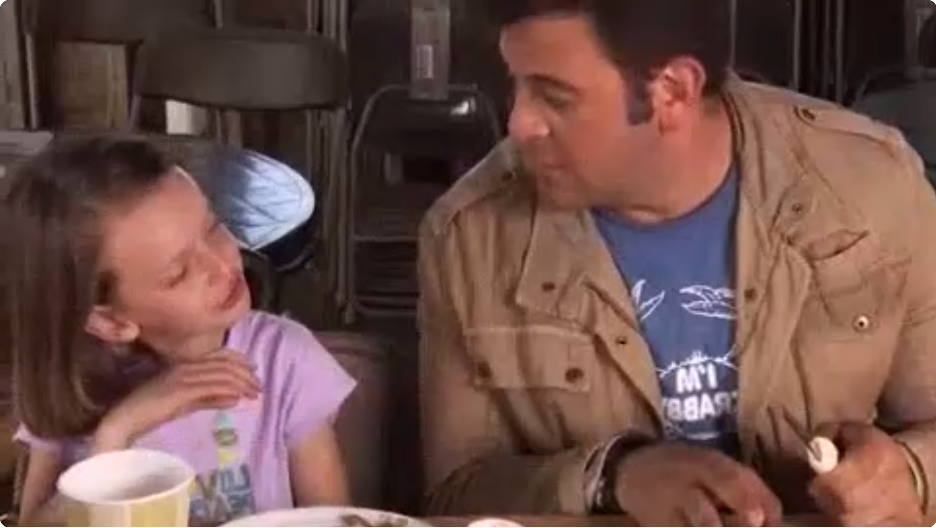
Credit: Man v. Food S2 E3 Charleston, Travel Channel.
On a scale from one to ten, these are, like, a ten!
Bowens Island serves as a case study in how to do steamed oysters right. It was opened in 1946 by May Bowen, current owner Robert Barber’s grandmother. The nondescript restaurant sits at the end of a live oak-lined dirt road, on the bank of a saltwater creek that feeds into the Folly River, which itself feeds into the Atlantic Ocean. Bowens serves oysters in the tradition local to the coastal Lowcountry region of South Carolina: roasted. During the October-April season, their oystermen harvest shellfish from the nearby marshes each day. After bringing them back to the restaurant, they clean the oysters of any mud and shovel them onto a grill. The oysters are then covered with salt-water soaked burlap sacks and left to steam. Bowens Island has gained recognition for their oysters, winning a James Beard America’s Classics award in 2006. As much as this restaurant has a special place in my heart, their methods of cooking oysters are by no means unique to this establishment. Oysters, and the larger event of the “oyster roast” are a deep-seated part of Lowcountry tradition.
Oysters have been consumed in coastal South Carolina for centuries. Before settlers arrived, indigenous people including the Sewee, Wando, and Edisto tribes consumed the shellfish, leaving behind shell piles, or middens.1 English settler colonists recognized oysters as a familiar food source, as different species of the shellfish can be found in tidal waterways around the world. In addition to eating the shellfish, they used the oyster shells as an alternative to concrete.2 Oysters were sold from street carts, boiled, and served at formal balls. The oyster roast was a common event, usually held around Christmas when the waters were cold enough and there was cause for celebration. One account from 1825 recalls the invitation, “‘join us for our Christmas festivities – an oyster roast.’ Nothing more. All knew what this meant.”3 The oysters were prepared in a way not too dissimilar from how Bowens does it, reportedly “poured on the live coals by the barrelfuls” and served, hot, soon afterwards.4 Guests were tasked with shucking the oysters, equipped with a specialized knife and “protective guards” in case the blade slipped. Shucking was the extent of the labor required by guests or hosts, as the cooking and preparation of the oysters and the other courses in the meal was carried out by enslaved people.
In antebellum Charleston, harvesting and selling oysters provided a source of income for enslaved people. One particular group of enslaved men became known as the mosquito fleet, catching fish, shrimp, and oysters to sell in town. This was challenging labor that required great skill, as oyster shells are razor sharp, and oyster clusters often hide beneath the thick mud that one easily sinks down into. The sea itself also posed a danger for the fishermen: “in 1848, several drowned when their boats capsized in a winter storm while returning from an oyster expedition.”5 The mosquito fleet continued to harvest fish, shrimp, and oysters after emancipation and into the 20th century. Refrigerated fishing vessels outcompeted traditional methods of fishing, and hurricane Hugo in 1989 destroyed their dock and effectively disbanded the fleet.6 Black labor was and remains a part of oyster consumption in South Carolina, and the oyster roast has continued into the present Lowcountry tradition.
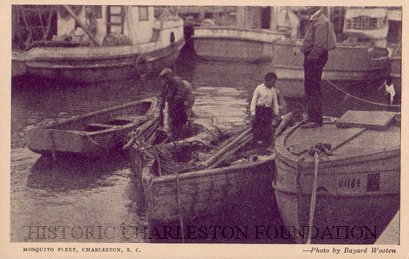
Credit: Lowcountry Digital Library
Today, the oyster roast continues in casual backyard settings and social gatherings. The event can be held for nearly any occasion, church socials, fundraisers, and holiday celebrations among them. In fact, oyster roasts are so common in the state that in 2003, “nearly all the oysters produced in South Carolina…are sold in shell and utilized in roasts.”7 I have dined at Bowens more times than I’ve been to backyard oyster roasts, but I did spend a memorable boxing day shucking oysters in my uncle’s backyard. It was bordering on too cold to be outside in my fall-weather jacket, likely in the high 40s. My uncle poured the oysters into a steel steamer pot over a propane fire, and we stood around chatting while they cooked. I donned heavy duty gloves and a shucking knife and got to work as soon as the steaming oysters hit the white plastic of the folding table. Shucking proves to be a delicate operation. You must carefully jab at the hinge that holds the oyster together, finding a precise hold on the craggy cluster so as to not cut your own hand. Open it with a twist rather than a push. Make sure it’s a clean cut, that no fragment of shell gets into the glistening interior. Wipe off your knife on a cloth before detaching the creature from its shell via the single anchoring muscle. Now you can enjoy its tender flesh. Upon opening an oyster during this boxing day oyster roast, I found a small pinkish crab the size of a pea inside the shell, cooked with the oyster. These “oyster crabs” are supposed to be a sign of good luck. There exists a mythology of guardianship surrounding this unique little crustacean. The crab supposedly protects the oyster in exchange for a home. One of these tales posits that the oyster crab “played the part of the ‘King’s Jackal,’ who hunted by night for his majesty the lion… and on returning from the hunt, should it find the house closed, would give a cry, which was recognized by its host, the door instantly opened, and it was allowed to enter.”8 This story is false, albeit fascinating. Instead the crab enters the oyster in its microscopic larval form and lives its entire life inside the mollusk’s shell. But the intrigue of the oyster crab lives on in the superstition of good luck that I learned from my family.
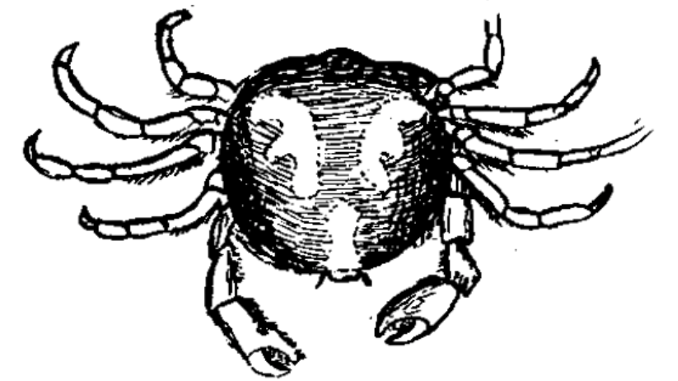
Credit: The Guardian of the Oyster
Oysters can, of course, be prepared in a wide variety of ways. I present the oyster roast in contrast to the raw oyster, which is served today at upscale oyster bars around the country. Over the past summer, I dined at one such oyster bar in Charleston with my dad and his girlfriend. My dad grew up in Charleston, and despite multiple moves elsewhere, always seems to find himself returning to his hometown. Tracy, my dad’s girlfriend, is from New York City and lives in Mount Pleasant, a suburb of Charleston for wealthy transplants. Before my family moved from Charleston in 2011, my dad wrote a country song called “I Can’t Afford to Live Where I’m From,” mourning the influx of New Yorkers and the like to his hometown. “The house that I wanted, oh it used to look haunted, just sold for 3.1, and the resident’s got a Northern accent, I can’t afford to live where I’m from.” When he got back on dating apps, he knew he didn’t want to date a New Yorker, and didn’t want to date someone in Mount Pleasant. Well. Star-crossed lovers? We ordered a dozen raw oysters between the three of us, selecting a couple different varieties, none of which were sourced from South Carolina. We also ordered hush puppies and fried okra, because four oysters apiece does not a meal make. Over the course of conversation, Tracy recounted the tale of a wild night with a college friend at an oyster bar in NYC, wherein her friend got full from eating oysters alone. The punchline being can you imagine how much that cost? Later, my dad confided to me his thoughts on this anecdote. “I need to take her to an oyster roast.” There exists a clear cultural divide between the oyster as I and my father understand it, in the context of all-you-can-eat oyster roasts, and the oyster as Tracy and others understand it, as a luxury food item served on ice on the half shell with champagne.
Nearly all the oysters produced in South Carolina…are sold in shell and utilized in roasts.
Victor G. Burrell, Jr.
south Carolina oyster industry, a history
Oysters found immense popularity in New York, historically a common food among every social stratum. In 1842, New Yorkers were eating 6 million dollars worth of oysters each year.9 These oysters were being sold from cellars, stalls, and fine dining restaurants in various preparations, but mostly cooked varieties. Between 1859 and 1865, “Oyster Patties à la Béchamel” appeared on Fifth Avenue Hotel menus a total of 178 times, making it the most common dish to appear on the menus of the fine-dining restaurant during this time period.10 “Oysters Baked in Shell” also made it to the top ten, with a total appearance count of 160. Downing’s Oyster House offered such options as oyster pie and an oyster-stuffed poached turkey, the latter being quite a unique menu item.11 Raw and stewed oysters were also commonly sold by street vendors for pennies in the late 19th and early 20th centuries.12
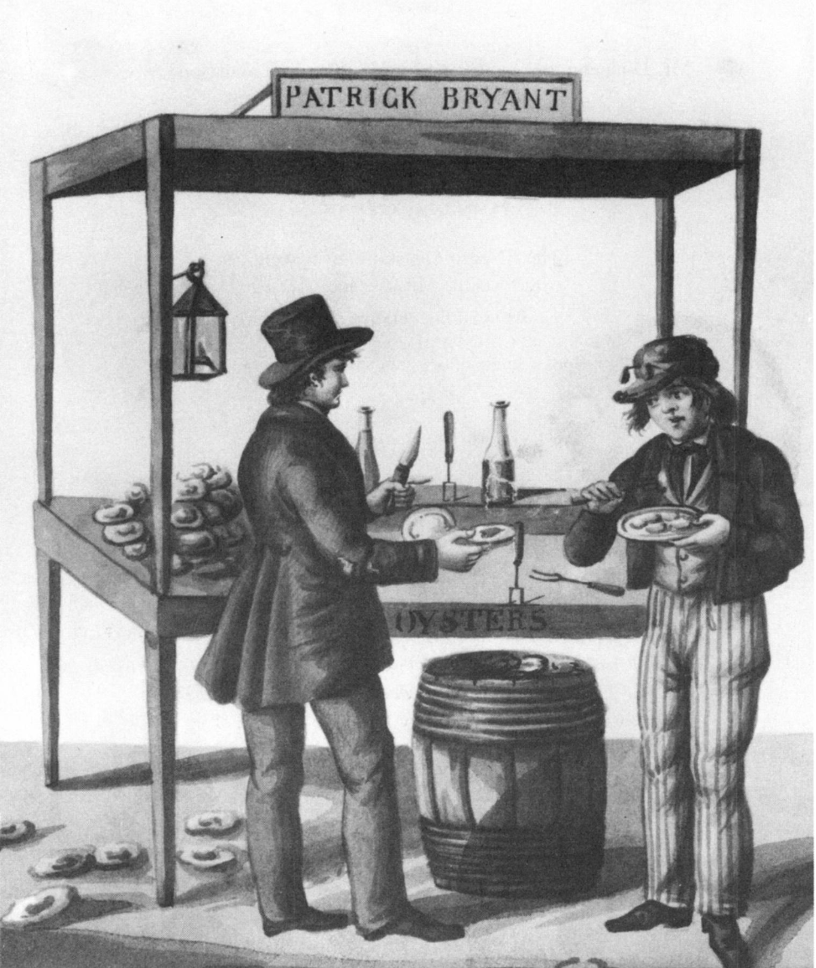
Credit: Oyster Stand, watercolor on paper, n.d., by Nuotino Calyo. Collection of The New-York Historical Society, New York, New York (1980.31). Screenshot from http://www.jstor.org/stable/23182523
The ubiquity of the oyster in New York declined in the first quarter of the 19th Century due to overharvesting and pollution of waterways. Oyster shells were all too often discarded or used as building materials. The best thing to do for future oyster populations is to throw the shells back into oyster beds so oyster spawn has an anchor on which to cling and grow. As filter feeders, oysters are excellent at cleaning waterways, which means they are good at absorbing pollutants like heavy metals. By 1927, the oysters surrounding New York were too poisoned to eat, though because oysters were so ubiquitous in the city, New Yorkers were still getting their oyster fix from other coastal areas.13
The introduction of ice and refrigeration, in combination with railroads, allowed raw oysters to be transported across the country and established the raw oyster as a luxury food item. It became pricey to get cold, raw, fresh oysters when far from the coast. In 1879 a buyer from Prescott, Arizona purchased raw oysters to entertain guests. The express shipping costs alone came to $96.25, nearly 3000 dollars today.14 For those who didn’t live near thriving oyster populations, the shellfish had to be shipped in, and so eating it raw and fresh became a sign of wealth. Because New York’s oyster populations were decimated, they had to get their oysters elsewhere, and the high costs of keeping oysters fresh during shipping led to oysters becoming a luxury good.
Luxury still colors the culture surrounding the raw oyster, even as refrigeration is ubiquitous and shipping shellfish has become cheaper. Like fine wine, different varietals of oyster are said to have their own flavor notes: briny and sharp, meaty and mild. To some, raw oysters have their own terroir, distinct flavor profiles based on the composition of their regional tidal beds. While the beverage of choice at an oyster roast is cold beer, oyster bars suggest pairings of champagne and craft cocktails. Since my introduction to the animal, I have embraced the salty snot of a raw oyster, a texture that turns many people off of the mollusk. Even after food poisoning from a not-so-fresh raw oyster in Pittsburgh left me doubled over in the middle of the night, I find myself back in oyster bars. I prefer to eat them plain, unadulterated with hot sauce or lemon, searching for the tasting notes, entertaining the idea of terroir. I like eating them most when someone else is paying.
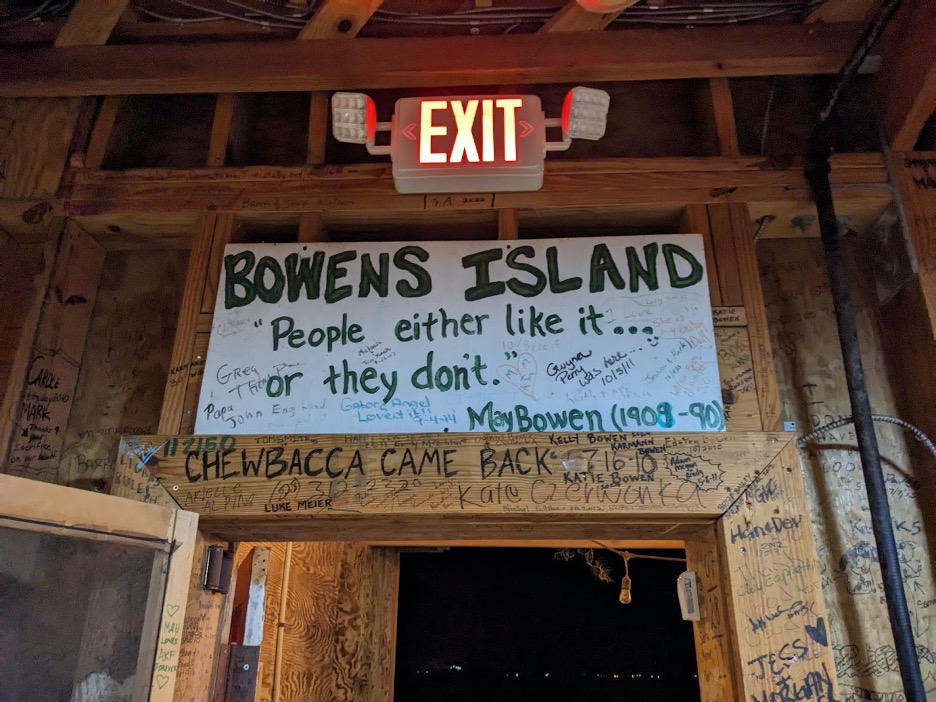
I made a pilgrimage back to Bowens Island in late March, driving twelve hours from my midwestern liberal arts college with two friends in tow. On the Tuesday night of break, we ventured out to Bowens island to meet up with my dad and Tracy. After driving down a gravel road and parking, we saw the oystermen hosing the mud off buckets and buckets of oysters in the overcast dusk. We ventured up the winding wooden ramp to the main space of the restaurant, lit outside by string lights and overhead fluorescent ones inside. A particle board sign in the main dining room proclaimed in hand painted green lettering “Bowens Island: ‘people either like it, or they don’t,’” a quote attributed to founder May Bowen. Every raw wood and cinder block wall was covered in sharpie love letters from customers recording their history with the place. We entered just as my dad and Tracy were walking up to the counter, leading to me and my friends hurriedly consulting the menu and ordering altogether too much food: plates of fried shrimp, fish, french fries, and hush puppies, a dozen clusters of steamed oysters, and 18 oysters on the half shell.
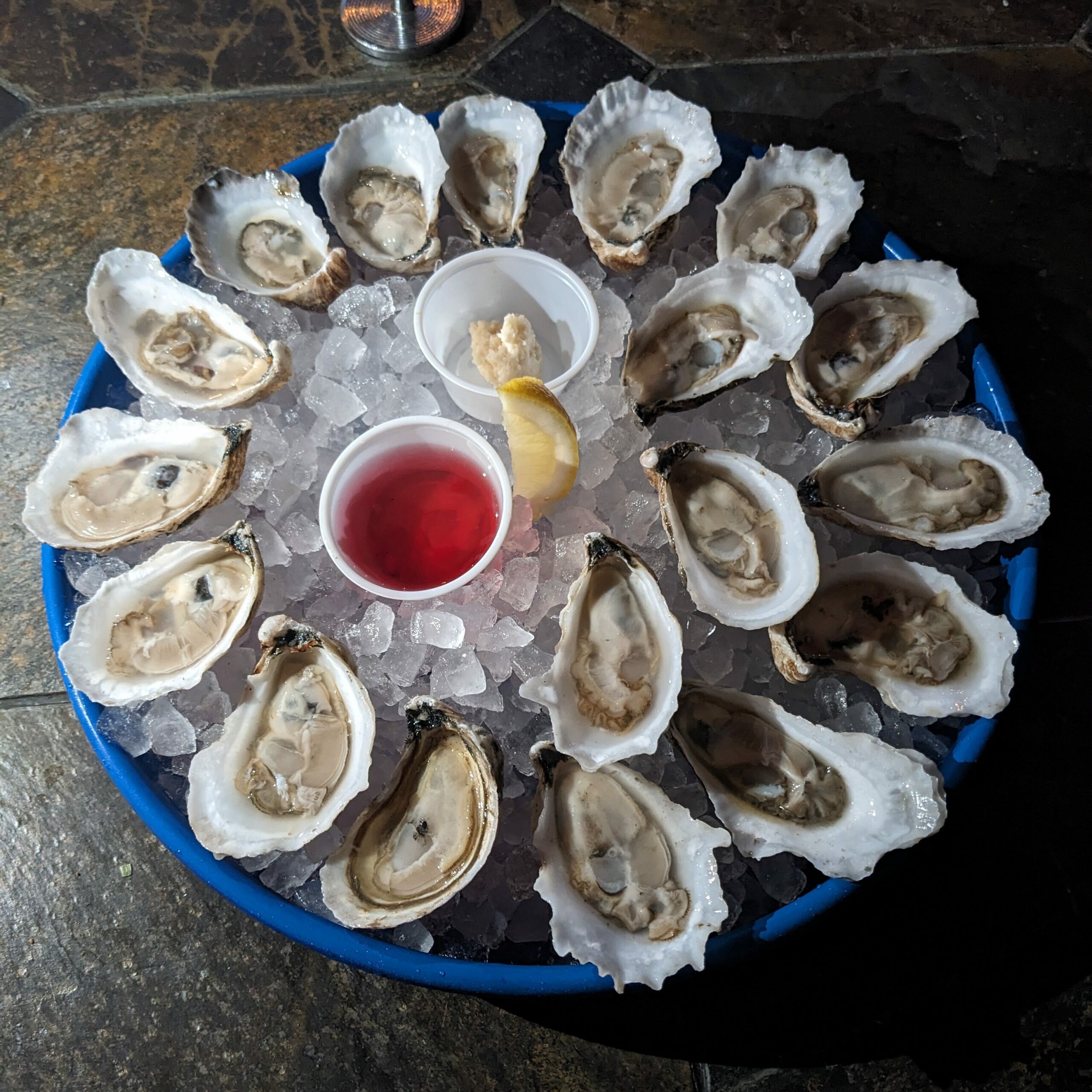
In recent years, Bowens has changed their menu in response to changing tastes of their clientele. They notably offer local raw oysters on the half shell, a varietal humorously named “perky sea cups.” Alongside this new addition, Bowens continues to serve their signature steamed oyster clusters. The raw oysters arrived first on ice, served with lemon, horseradish, and red wine vinegar. They were extremely salty, with a clear liquor and a slight meatiness from the animal itself. As conversation continued, Tracy told me about her appreciation for steamed clams, having grown up with summer trips to New England. I was struck by how our tastes are so influenced by what we grew up with and what we find comfort in. My dad ordered twelve clusters of steamed oysters, going downstairs to pick up the order from the steaming room along with cloths, shucking knives, and two plastic five-gallon buckets in which to discard our shells. I went back to the bar and ordered a citrusy beer on the recommendation of my dad and an anecdote I came across in my research, that reportedly “time and time again…a guest who has just consumed a succulent oyster followed by a sip of cold beer will spontaneously bow his head in a moment of silent prayer.”15 Turns out I’m not that big of a beer person. The oysters did not disappoint. In the marshy mud they grow on top of one another, so a cluster of oysters can have anywhere from four to twelve different organisms on it. The hunt for more tender oyster flesh in a cluster is one of the greatest joys in this operation. One of my friends admitted that she preferred the taste of a raw oyster to the steamed ones, but that the novelty of shucking made the dining experience fun anyway.
The hunt for more tender oyster flesh in a cluster is one of the greatest joys in this operation.
The evening went on and the sun was long gone by the time we were wrapping up. By way of saying hello to the fluffy dog at the table text to us, we made conversation with the dog’s owners, friends from Ohio celebrating being together. Being in our last semester of college, my friends and I had surface-level “what comes next” answers locked and loaded for when they inevitably asked. We started bussing our table after one of them asked pointedly if we were liberals. Altogether it was a lovely night with friends and family in a place with a storied past and new dishes to introduce. On the drive back to the house with a full belly, I felt like I had bared and fed a part of my oyster-loving soul.
Phoebe Brown OC ’24 is a lover of seafood and most food majoring in environmental studies. They are into sustainable agriculture and food justice, and are often dreaming about the perfect tomato sandwich.
Footnotes
- Judy Drew Fairchild, “More About Shell Middens; Archives Talk Saturday,” Dewees Island Blog, January 20, 2011, https://deweesislandblog.com/2011/01/20/more-about-shell-middens-archives-talk-saturday/. ↩︎
- Victor G. Burrell, Jr. South Carolina Oyster Industry, A History (V.G.Burrell, 2003), 3. ↩︎
- Burrell, South Carolina Oyster Industry, 5. ↩︎
- Burrell, South Carolina Oyster Industry, 5. ↩︎
- Burrell, South Carolina Oyster Industry, 4. ↩︎
- Charleston Museum. “Mosquito Fleet,” https://www.charlestonmuseum.org/research/collection/mosquito-fleet/2D065EF2-48F1-4FD5-8F43-055852690122 ↩︎
- Burrell, South Carolina Oyster Industry, 29. ↩︎
- Benjamin Sharp. “THE GUARDIAN OF THE OYSTER.” Scientific American 83, no. 5 (1900): 71. http://www.jstor.org/stable/26121595. ↩︎
- John H. Hewitt, “Mr. Downing and His Oyster House: The Life and Good Works of an African-American Entrepreneur,” New York History 74, no. 3 (1993): 237. http://www.jstor.org/stable/23182523.
↩︎ - Paul Freedman, James Warlick, “High-End Dining in the Nineteenth-Century United States,” Gastronomica 11, vol. 1 (February 2011): 46.
↩︎ - Hewitt, “Mr. Downing and His Oyster House,” 233 ↩︎
- Carmen Nigro, “History on the Half-Shell: The Story of New York City and its Oysters.” New York Public Library, June 2, 2011, https://www.nypl.org/blog/2011/06/01/history-half-shell-intertwined-story-new-york-city-and-its-oysters#2.
↩︎ - Nigro, “History on the Half-Shell” ↩︎
- Paul L. Hedren, “The West Loved Oysters Too! A Look at That Time in America When Those Briny Bivalves Were All the Rage, Even beyond the Missouri River,” Montana: The Magazine of Western History 61, no. 4 (2011): 7. http://www.jstor.org/stable/23127900. ↩︎
- Burrell, South Carolina Oyster Industry, 29. ↩︎
