Recipe Reflection
As I alluded to in the note section of my recipe, my “life story” is somewhat woven into this. If you allow me to give a brief overview, my reflection will make more sense. My father was diagnosed with terminal brain cancer when I was six years old. He died eight years later when I was in 8th grade. My family has always loved food, making it, eating it, and growing it. The household had non-traditional gender roles in the sense that my dad was the person who spearheaded cooking and feeding the family, not my mother. Towards the end of his life, when his mobility declined significantly, he insisted on making meals as best he could. Mom and Dad were both emergency medicine physicians, and Dad was involved with the town ambulance service as a passion project. Because of this, my parents were well-known community members in my tiny hometown. The community was so generous when my father was ill. People brought meals over roughly three nights a week and helped when possible. Though the kindness of people bringing food over never got old, the food they brought did!
Nearly every meal was some lasagna or other shape of pasta with red sauce and breaded chicken or meatballs. The American Italian dish is a comfort food for many; thus, it would be the go-to choice for a meal during a difficult time. But with the sheer quantity of it that we received, even to this day, I would be thrilled never to eat a red sauce pasta again. Now and again, a non-Italian dish would grace our tables. The one I remember most clearly was a detectable Caesar salad. Crunchy, fresh, tangy dressing with creamy and nutty cheese on top. This delicious creation was thanks to the wife of another physician who worked with my parents. This salad was a delectable treat occasionally, but the years passed, and my family adjusted to a new normal. A normal without my dad, and then with my mom’s new husband and his children. A normal that supposedly meant we were not in crisis anymore; thus, there was no Caesar salad.
This past spring, my family found itself in the unfortunate familiar situation of another surprise cancer diagnosis. Except this time, it was my mom who was sick. We were again, inundated with pasta covered in red sauce, and this Caesar salad appeared. Initially not thinking much of it, I munched on a heaping bowl for lunch one day. What resulted was a gush of emotions and memories I had long forgotten, but eating this salad again had unlocked. I had always understood that food is more complex than just caloric sustenance, but at this moment, I understood food as memory. Dinners with my father, the angst of middle school years, and the feeling of impending doom that colored much of my childhood all came surging back. This experience echoes a quote in Kennan Ferguson’s book Cookbook Politics, “Food operates on the body in surprising and powerful ways, and the body craves and responds to taste according to expectations anticipated and formed by those who prepare food” (Ferguson, 2020, p. [Page 9]). Later, I asked Laura, the woman responsible for the salad, for the recipe. The next day, a printed version was on my front porch with her beautiful handwritten tweaks.
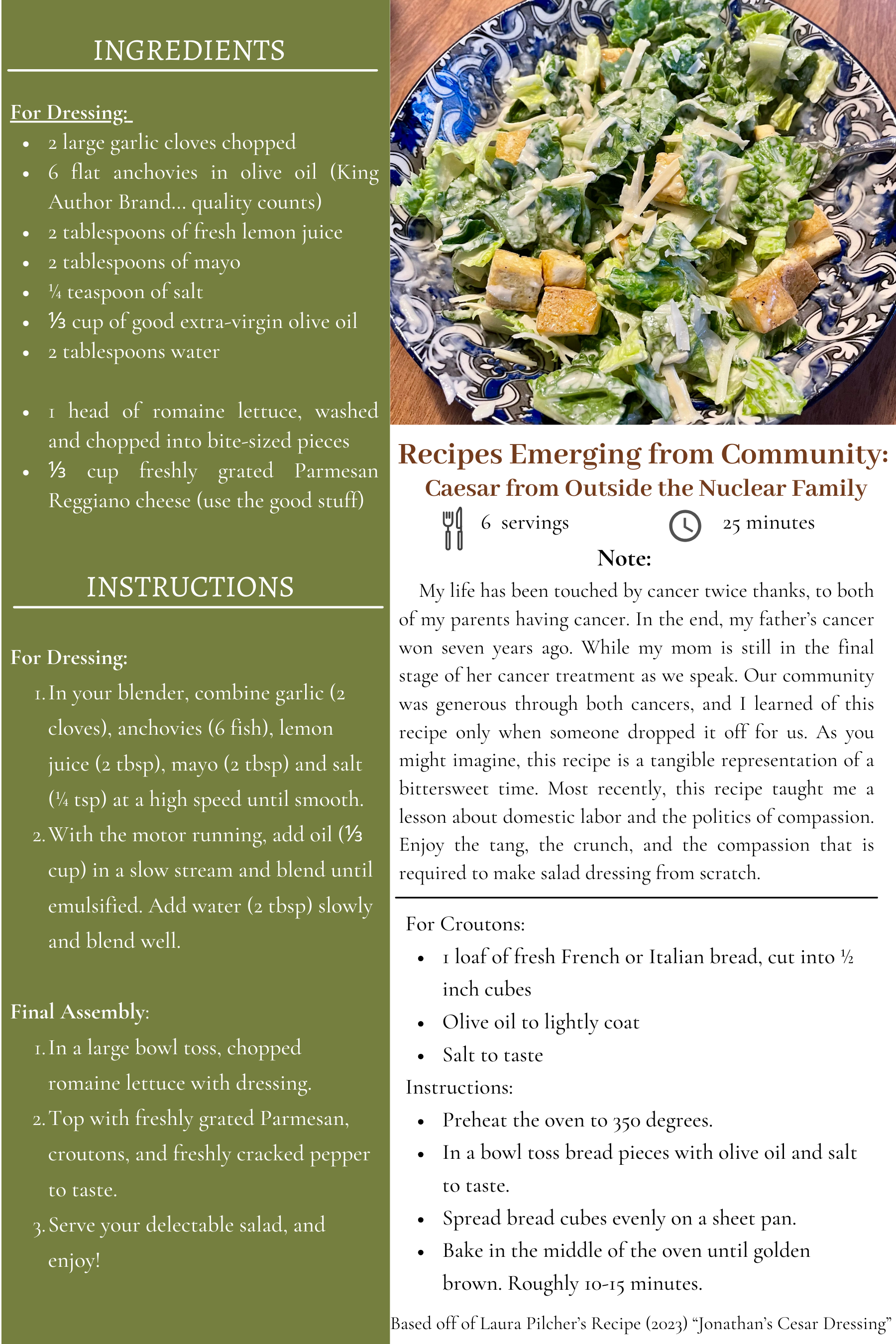
Now that you have been equipped with the context that follows this recipe, we can examine the political message within my version of the recipe. My goal with this recipe was twofold: firstly, to politicize support from a wider community instead of exclusive reliance on the nuclear family, and secondly, accessibility in the recipe formatting. Even with the social progress that has been achieved in our modern world, it is easy to find ways that patriarchy influences our norms. One example is the gendered nature of those who typically feed the family; in Fielding-Singh’s book How the Other Half Eats, she details the gendered norms of family eating practices. She writes, “Even when both parents work outside the home, mothers continue to do most of the foodwork. They grocery shop, cook, clean up, and pack lunches and snacks. They also shoulder feeding’s cognitive and emotional labor” (Fielding-Singh, 2021, p. [Page 22]). I have always had a more parental role in my family as the oldest child, but with my mom’s cancer treatment being so rigorous, most of the domestic labor fell to me. The nuclear family is a product of capitalism, and if we did not live in a capitalist society, the nuclear family would be obsolete, and we might return to a more communal style of living. Childrearing, cooking, educating, physical labor, etc., were handled by multiple people on a larger scale. But because we live in a capitalist system the way that the Ceasar dressing recipe came into my life was political. A tragic event forced my family to rely on support stemming from outside of the nuclear family and be cared for by a larger community.
Furthering this point, Ferguson writes, “Both those who make the food and those who eat it enter into relationships of authority, power, memory, belonging, and creation” (Ferguson, 2020, p. [Page 9]). When the labor of meal planning, shopping, cooking, and delivering is outsourced to those outside the nuclear family, it forges a relationship. This relationship of care and compassion is political in nature since it is done without the expectation of reciprocation. Whoever donates their labor of time, energy, money, and food stands to gain nothing. In the capitalist system of our world, this is an illogical expenditure of resources.
I attempted to highlight the politics of community care and the non-normative nature of a community supporting a nuclear family through the title “Recipes Emerging from Community: Caesar from Outside the Nuclear Family,” which is somewhat clunky and awkward but also intriguing. In addition, I included an introductory note that explained the title and some of the context.
Accessibility was another political choice within my recipe. I have dyslexia, which makes reading difficult and makes my reading comprehension different from the norm. Dyslexia is a neurological condition resulting from a different makeup of the brain, wiring-wise and chemistry-wise (Dyslexia at a Glance, n.d.). One of the challenges my dyslexia presents is following the end of a line and starting the next line or words very hard. The ingredients are frequently listed when reading a recipe with the measured amount at the top. However, when the instructions are written, the ingredient is listed, but typically not the amount. My difficulty tracking text with my eyes makes it cumbersome to constantly relocate my eyes to multiple places, measure the ingredients, combine them with other ingredients, and repeat the process. Hence, in my recipe, the measurements are listed twice. Once at the top next to the list of ingredients, which is standard, and again when the instructions are given.
My recipe was partially successful with its political messages. My version of the recipe did make it more accessible for people with learning disabilities, myself included. Even the simple formatting change of including the measurements a second time makes it a much faster process. Some might argue that having the measurement amounts listed twice disrupts the typical aesthetic flow of the recipe. However, the people concerned about a recipe’s aesthetics are likely not those who need accessibility.
On the whole, my recipe was potentially too text-heavy. My larger political point of an external community supporting a nuclear family, thus asserting a socialist-leaning politics of collective care, was perhaps too broad of a message to fit into this recipe comprehensively. Other than the title and the note section, I was not able to successfully weave a message of collective care. If I were to do this again, I would have included Laura’s handwritten tweaks of the recipes while also including my own tweaks. Hopefully, it would be done in a way that might showcase the multiple people/versions of this recipe, thus more clearly exhibiting the community that has shaped it.
Natalie Todd-Weinstein OC’25 is a Politics and Comparative American Studies double major with a minor in Law & Society. She grew up in Cape Cod, MA. She loves cooking, eating, and playing with her dogs. This summer she will be completing a Food Justice Internship with the Mellon Foundation.
Sources:
- Recipe Based off: Laura Pilcher’s Recipe (2023) “Jonathan’s Cesar Dressing”
- Ferguson, K. (2020). Cookbook politics. University of Pennsylvania Press.
- Fielding-Singh, P. (2021). How the other half eats : the untold story of food and inequality inAmerica. Little, Brown Spark.
- Dyslexia At a Glance. (n.d.). International Dyslexia Association. https://dyslexiaida.org/dyslexia-at-a-glance/
