The Significance of Aunt Esther's Cooking
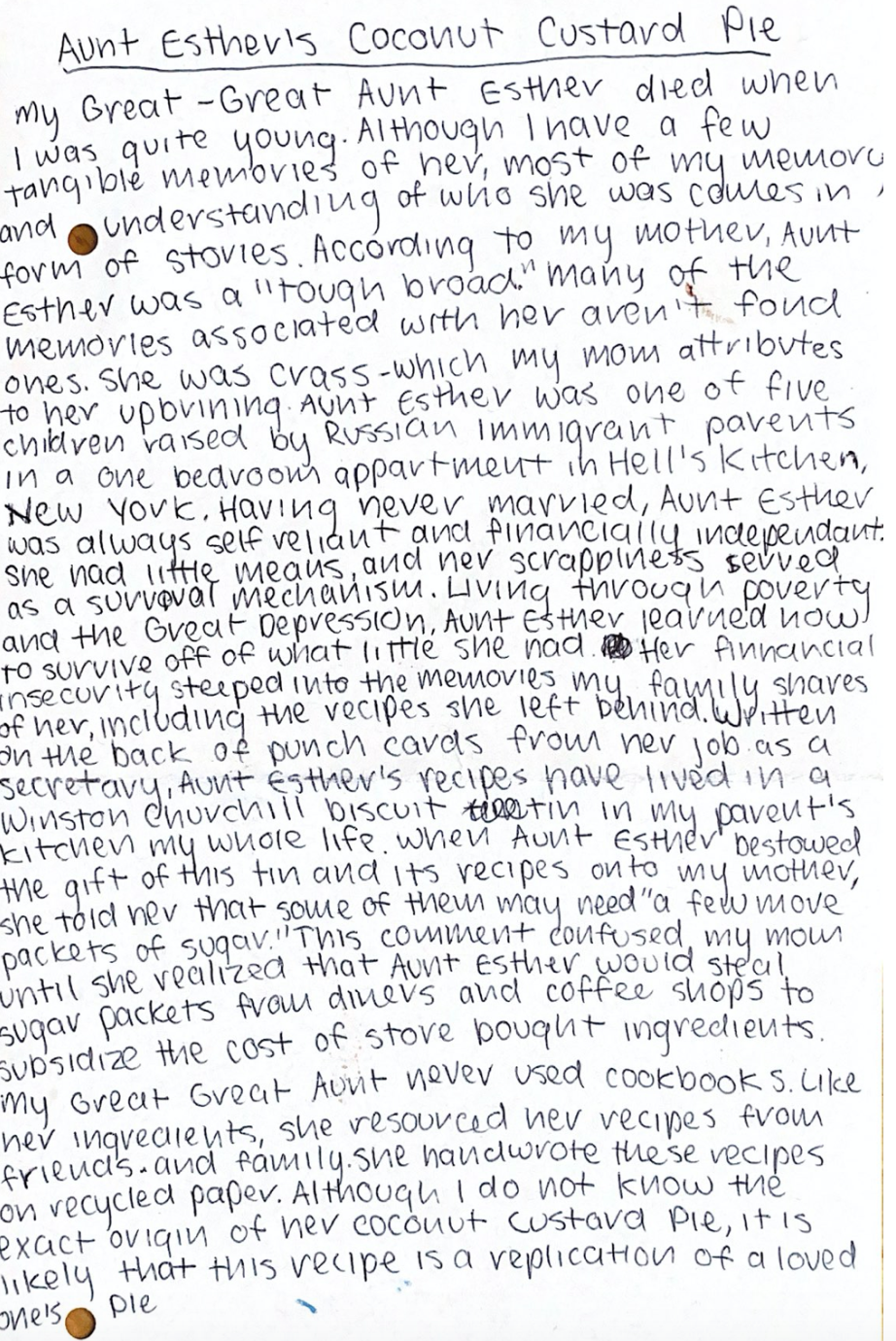
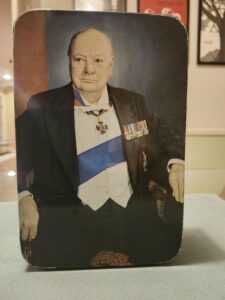
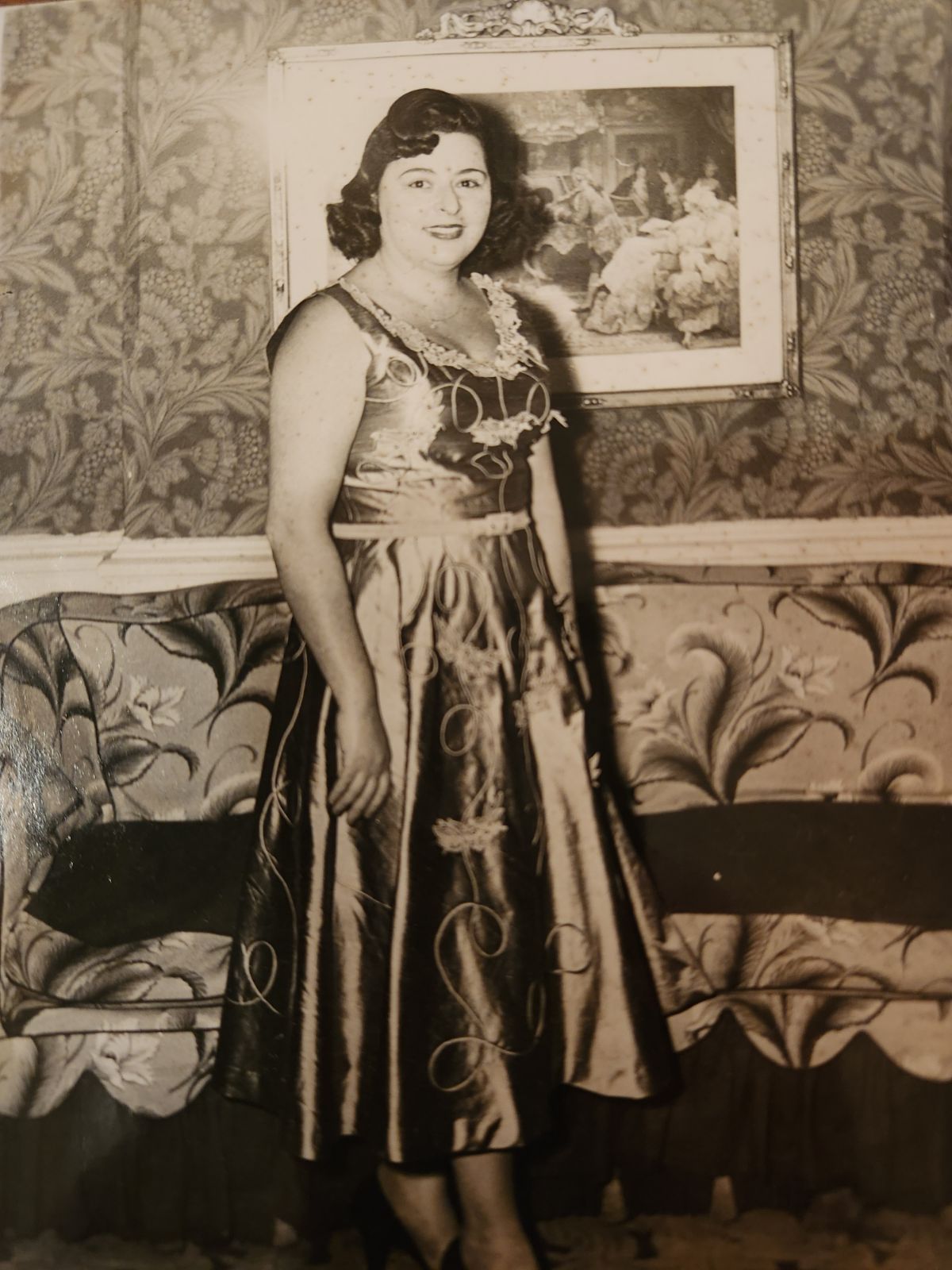
My Great Great Aunt Esther is not always remembered in my family for fond reasons. The memories my mother recollects of her characterize her as a crabby spinster. The daughter of poor Russian immigrants, Aunt Esther was born in 1915 and raised alongside her four other siblings in a one bedroom apartment in Hell’s Kitchen, New York. As my mom says, she “didn’t have two nickels to rub together.” Brought up in a situation of financial insecurity, and living through the Great Depression, Aunt Esther was taught to be scrappy and resourceful from a young age. Though she gained a few nickels to rub together through her secretary job for Texaco, Aunt Esther never married and always had humble means. Her resourcefulness stuck with her throughout her whole life and even seeped into the recipes she left behind with my mother in a Winston Churchill biscuit tin. Written on the back of recycled punch cards, Aunt Esther’s recipes leave familial memories of financial insecurity, resourcefulness, and the fatty comfort of Betty Crocker homestyle cooking.
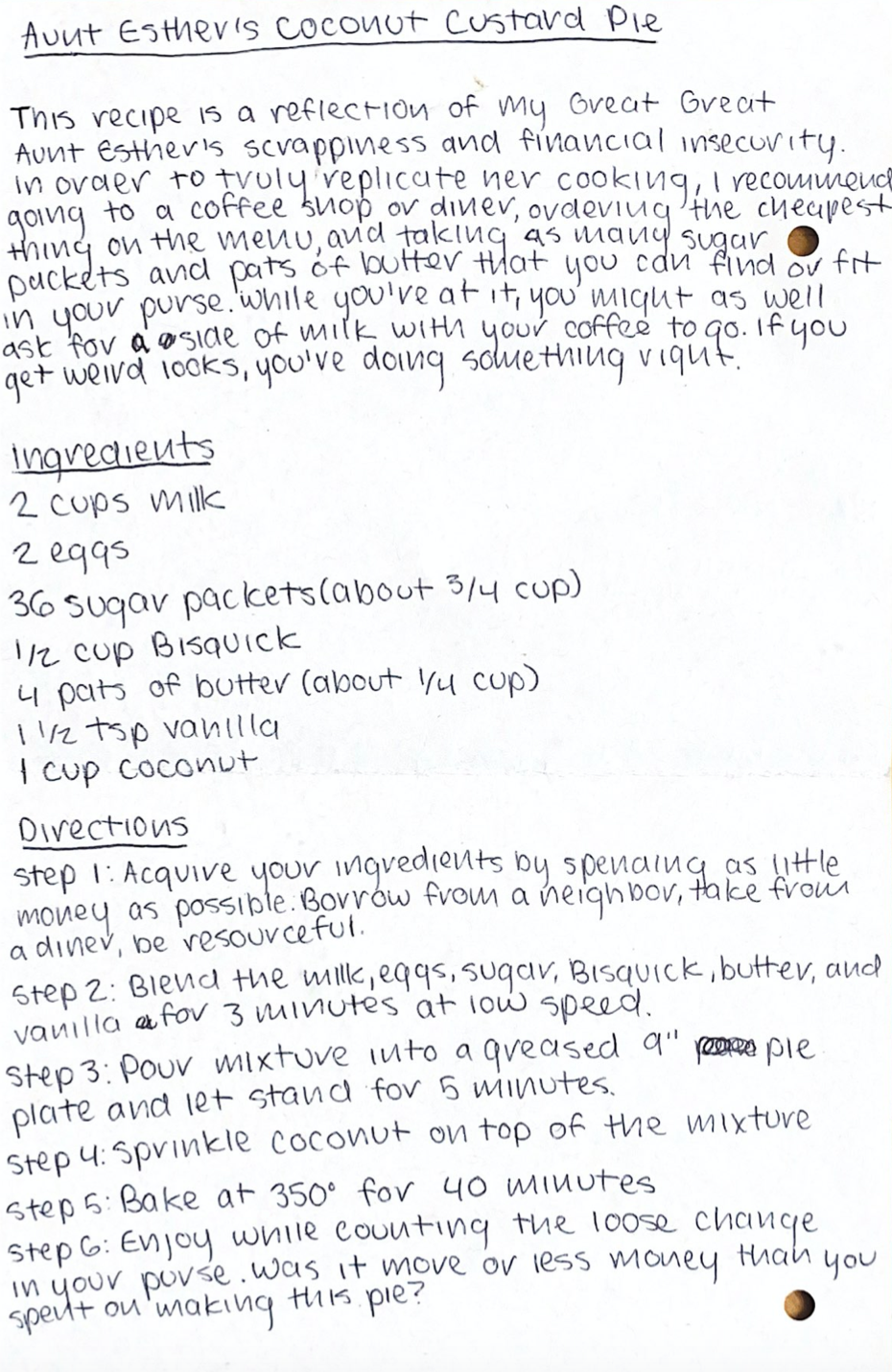
The recipe I am chosen to replicate comes from one of the many punchcard dishes that Aunt Esther kept in her Winston Churchill tin. In homage to her scrappiness, I hand wrote the Coconut Custard Pie recipe on a scrap piece of paper I found in the art studios. While staying true to the ingredients and directions of the recipe, I choose to replace the measurements of sugar and butter with the amount of free diner packets needed to produce this Coconut Custard Pie. Always a penny pincher, Aunt Esther was known to use the sugar packets one might find in a diner or lunchroom for her cooking. Because I am hoping to replicate the financial and emotional context of Aunt Esther’s cooking, I call for these ingredients to be resourced by the cook using as little money as possible. The memories that my mother shares of Aunt Esther reflects her contentious relationship with money and poverty. In recreating this pie, I believe that the process of acquiring the ingredients is as important as the taste itself. Thus, in order to authentically taste the memory of Aunt Esther, this recipe requires equal parts financial resourcefulness and butter.
Aunt Esther’s Coconut Custard Pie is not special to me because of its taste. I have never eaten this pie recipe, nor was I able to make it before doing this assignment because I do not own a blender or a pie dish. For me, this recipe is significant because it tells the story of my Aunt Esther, who I believe was an often misunderstood member of my family. A lot of the stories my family shares of my great great aunt make her the butt of the joke. As my family has become comfortably middle class, the ends to which Aunt Esther would go to save money becomes laughable now. Though I met her a few times when I was a young child, I never got to know Aunt Esther for who she was. Through my interest in her recipe tin, however, I feel as though I am beginning to understand the complexities of Aunt Esther’s life. While my take on her recipe is written somewhat tongue in cheek, I also include memories my mother has recollected of her to give nuance to the pie and my aunt. In doing so, I borrow from the methods of Angela Dimayuga, whose Filipinx cookbook embeds family stories into the recipes they share. As Dimayuga complicates understandings of Filipinx cuisine through the telling of history and family stories, I too am attempting to complicate my own understanding of Aunt Esther and the recipes she has left behind.
Aunt Esther’s Coconut Custard Pie recipe and the memories it conjures reflects a political understanding of domesticity and class as it relates to cooking and food. When she sent me photos of the recipes in Aunt Esther’s Winston Churchill tin, my mother told me that many of them came with women’s names attached to them. Presuming that these were friends and family members who entrusted Aunt Esther in replicating their recipes, this method of creating a makeshift cookbook speaks both to the gendered and socioeconomic realities that influenced Aunt Esther’s cooking. Upon looking up “coconut custard pie recipe” on Google, I found a nearly identical recipe on the Betty Crocker website. I would not be surprised if Aunt Esther’s recipe came from the back of a box of Betty Crocker Bisquick. My great great aunt did not have the funds to buy a cookbook, let alone a pound of sugar. Instead, she resourced recipes through the kinship she had with the other women in her lives, one of those women likely being Betty Crocker. As Kennan Ferguson writes on the politics of cookbooks, he argues that recipes “connect cooks to one another, creating communities of sensation that can be replicated and transmitted from one kitchen to the next.” (Ferguson 9) While Aunt Esther’s tin of recipes is not a cookbook in the traditional sense, it too serves as an archive of the relationships she had with other women through the sharing of food. Unfortunately, memories of the women mentioned in these recipes are now lost to time, but hints of them exist in the handwriting of my Aunt Esther, as well as the replication of the food they shared.
While I was not able to bake Aunt Esther’s pie for this assignment, I believe that uncovering her recipes and memories allowed me to better understand the life of my great great aunt. Though I was too young to understand who she was when she was alive, I feel that through the memories my mother shared and the artifacts she left behind, I have been able to make sense of the archives of Aunt Esther’s life. While her memory at times is a funny one, I understand her now more than ever as a woman complicated by her financial and gendered reality. I can now paint a picture in my head of my aunt coming home from a long day of secretary work, in dire need of a cheap yet comforting treat. So she takes the sugar packets she took from the lunchroom and bakes herself a Coconut Custard Pie. The taste might not evoke much for me, but I’d like to believe that it made my Aunt Esther a slightly less crabby woman.
Works Cited
Dimayuga, Angela, and Ligaya Mishan. Filipinx: Heritage Recipes from the Diaspora. Abrams, 2021.
Ferguson, Kennan. Cookbook Politics. University of Pennsylvania Press, 2020.
Kitchens, Betty Crocker. “Impossibly Easy Coconut Pie.” BettyCrocker.Com, 23 Feb. 2023, www.bettycrocker.com/recipes/impossibly-easy-coconut-pie/dca95b46-58a1-4253-81ae-6091f4abf47c.
